
Las Vegas Can't Afford Its Own Houses. Build-to-Rent Is Filling the Gap.
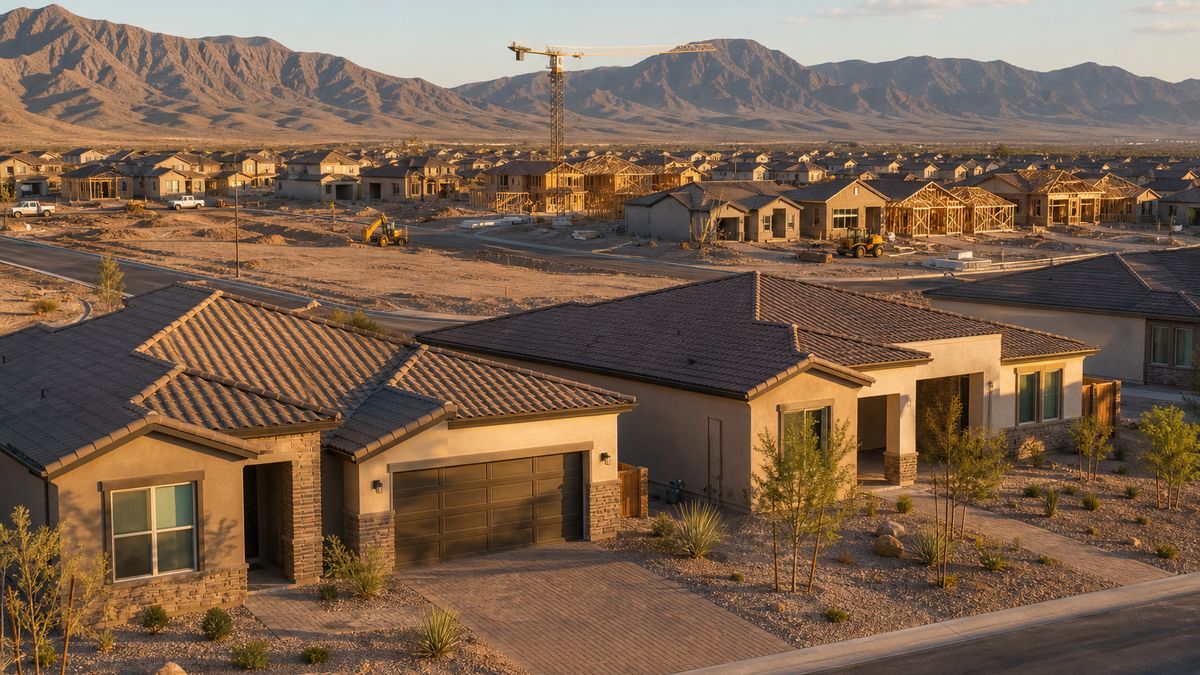
Las Vegas housing affordability has become the quiet constraint underneath every other growth story in the valley. The median existing single-family home in Southern Nevada sold for $470,000 in September 2026, only a little below the all-time high of $490,000 set in May and June, while new detached homes have been closing at medians near $590,000. Wages have not kept pace. The result is a growing group of households who earn good money, want a yard and a garage, and still can't make the numbers work on a purchase.
Into that gap has stepped build-to-rent: whole neighborhoods of new single-family homes and townhomes designed from day one to be leased, not sold. For investors, landowners and builders, it is one of the most interesting and most misunderstood plays in the valley right now. A new federal law has just changed who can buy what, apartment rents are still drifting down, and the valley's land and water limits haven't gone away.
We have spent our careers building, operating and exiting businesses, and our current pipeline includes a ground-up assisted living community, so we look at housing the way operators do: who actually lives here, what they can pay, and what it costs to deliver. Here is our take on where Las Vegas housing is heading, who wins, and how we would approach build-to-rent today.
Las Vegas has a structural gap between what homes cost and what local households can comfortably pay. Build-to-rent is the market's answer, and it just got a policy tailwind.
- The gap: Redfin data showed a Las Vegas household needed about $111,000 a year to buy the typical home in late 2025, versus about $69,000 to rent, a 61% income premium to own.
- The rental market: apartment rents are soft (about $1,479 a month, down 1.4% year over year in Q3 2026) with vacancy near 9%, but the construction pipeline is shrinking fast.
- The policy shift: the federal 21st Century ROAD to Housing Act limits purchases of existing single-family homes by investors with 350+ homes, but carves out newly built build-to-rent.
- Likely winners: well-capitalized BTR developers, owners of entitled infill and edge land with water, and builders who can pivot between for-sale and for-rent.
- Our view: BTR in Las Vegas is a long-term product, not a quick flip. Underwrite to today's softer rents, buy land and entitlements carefully, and partner with proven operators.
The affordability gap, in numbers
Facts first. According to Las Vegas Realtors, the Southern Nevada Multiple Listing Service, Home Builders Research, Redfin and Northmarq:
| Measure | Latest reported figure |
|---|---|
| Median existing single-family price | $470,000 (September 2026), flat year over year; record $490,000 in May and June 2026 |
| Median condo / townhome price | $290,000 (September 2026), down 1.4% year over year |
| Resale inventory without offers | 7,995 single-family homes, up 6.6%; about five months of supply, up from about four |
| Median new detached home closing | About $591,000 (October 2025, Home Builders Research) |
| Income needed to buy vs. rent | About $111,100 to buy vs. $68,900 to rent (Redfin, December 2025) |
| Average apartment asking rent | $1,479 a month, down 1.4% year over year (Q3 2026) |
| Apartment vacancy | 9.1% stabilized (Q3 2026) |
| Apartments under construction | About 6,100 units, down more than 25% since the end of 2025 |
Read those together and a clear picture emerges. Prices for owned homes are near record highs and barely moving, even as sales volumes fall and inventory builds. Mortgage rates remain well above the levels that set those prices. Meanwhile, apartment rents are flat to down, because the valley added a wave of new units in 2024 and 2025. The monthly gap between owning and renting is the widest it has been in years, and it is the single most important number for anyone deciding what to build.
Las Vegas doesn't have a housing demand problem. It has a payment problem. Households are here, jobs are here, and people keep moving in. What's missing is a product that lets a family live in a house without a $590,000 purchase and a 6%-plus mortgage. That is exactly the space build-to-rent occupies.
What build-to-rent actually is
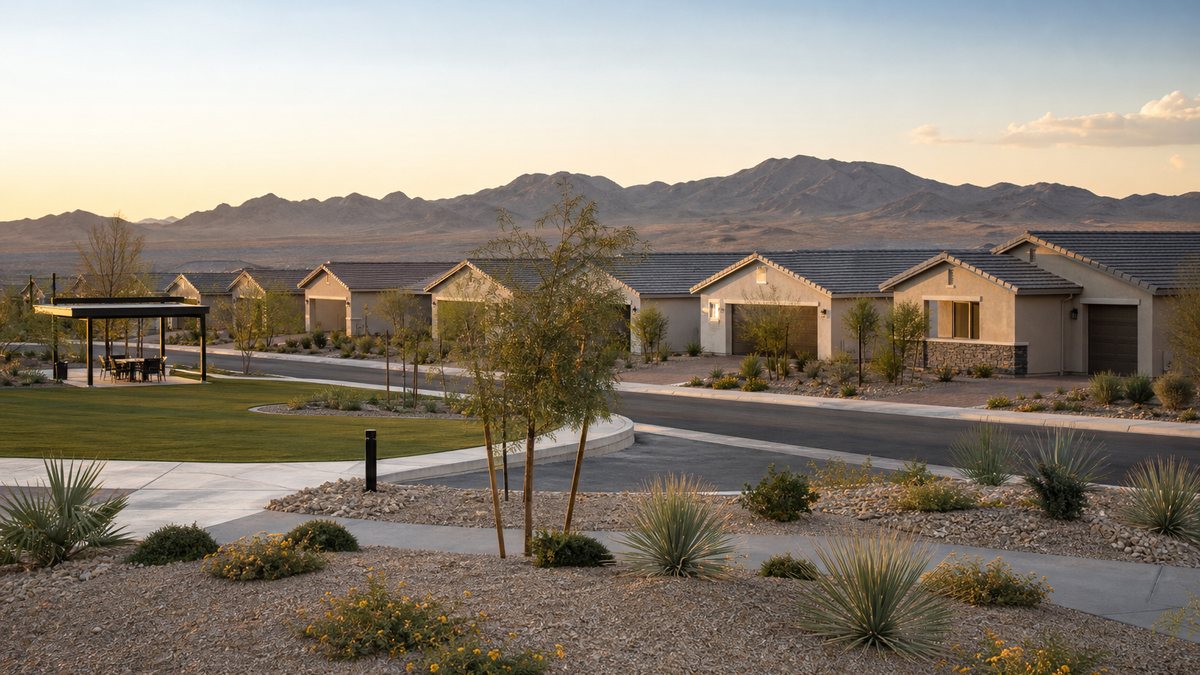
Build-to-rent (BTR) means a developer builds a community of single-family homes, duplexes or townhomes, then keeps and leases them as one professionally managed asset. Unlike scattered single-family rentals bought one by one, a BTR community is planned as a rental from the start: one owner, one management team, shared amenities, and floor plans chosen for durability and leasing appeal.
Las Vegas has become one of the most active BTR markets in the country. AMH (formerly American Homes 4 Rent) has said it has built more than 1,800 rental homes in the valley, with hundreds more in development, including its Dulce Springs community near Russell Road and Durango Drive in the southwest. According to local reporting, a typical three- to four-bedroom AMH rental runs around $2,500 a month, while a comparable new home to buy costs more than $500,000. AMH has pointed to a shortage of high-quality housing and the price gap as the main drivers of demand, especially in the Blue Diamond corridor.
Other national players have followed with townhome and detached rental communities across the southwest valley, Henderson and North Las Vegas, often financed with construction loans from institutional lenders and sometimes sold to institutional owners before they are even finished.
Who rents a new house instead of buying one
- Priced-out families: households earning solid incomes who can afford a monthly payment but not a down payment and today's mortgage rate.
- Relocating workers: people moving for jobs in healthcare, logistics, construction, gaming and the growing data center sector who want to try a neighborhood before buying.
- Downsizers and empty nesters: owners who sold at high prices and prefer flexibility and no maintenance.
- Remote and hybrid workers: people who need more space than an apartment offers but don't want to commit to a market they're still testing.
The new federal rules: a tailwind for BTR
The most important policy change for Las Vegas housing this year came from Washington. The 21st Century ROAD to Housing Act passed the Senate 85-5 and the House 358-32 in June 2026 and became law on July 11, 2026 without the president's signature, according to Latham & Watkins. It followed a January 2026 executive order aimed at large institutional buyers of single-family homes.
- The restriction: a "large institutional investor," defined as an entity controlling 350 or more single-family homes, may not buy additional single-family homes unless the purchase is an excepted purchase.
- The build-to-rent carve-out: newly constructed homes built or bought as part of a program to manage them as rentals are excepted, whether in rental-only or mixed communities. An earlier draft that would have forced sales to owner-occupants after seven years was dropped.
- Other exceptions: renovate-to-rent, certain lease-to-own programs, foreclosure-related acquisitions and some age-restricted housing, among others.
- No forced sales: existing portfolios do not have to be sold.
- Penalties and reporting: civil penalties of up to $1 million per violation or three times the purchase price, plus reporting to HUD.
Analyses differ on exactly when the purchase restrictions bite. HousingWire reported the restrictions took effect on enactment, while Latham & Watkins puts the effective date at January 7, 2027. Treasury, working with HUD, FHFA and the SEC, is authorized to write the implementing rules. Anyone structuring a deal should get current legal advice.
The law closes one door and props open another. Large investors can no longer simply outbid families for existing resale homes, but they can still build new rental supply. In Las Vegas, that pushes institutional capital toward new construction, which means toward land, entitlements, builders and the local partners who can deliver them. That is a meaningful shift in who has leverage.
Nevada's own push: AB540 and attainable housing
The state has also stepped in. Governor Joe Lombardo's AB540, passed in the 2025 legislative session, created the Nevada Attainable Housing Account with about $133 million for middle-income housing. The state announced $86.1 million in awards in February 2026, covering developer loans for land purchases, grants to local governments to offset building and permit fees, down payment assistance and some low-income rental funding. The state expects nearly 6,500 units statewide to be supported. One early Las Vegas example is Paradise Trails, a 29-home infill subdivision in the southeast valley.
Six thousand units is helpful, but it is small next to the scale of the gap. Most AB540 money is short-term loans meant to recycle. It nudges the market; it doesn't replace private capital.
Weighing a housing or build-to-rent deal in Las Vegas?
We help landowners, builders, family offices and investors pressure-test underwriting, structure joint ventures and plan execution. Tell us what you're looking at.
The rental market is soft. Why that's not the whole story.
If BTR is such a good idea, why are rents falling? According to Northmarq's Q3 2026 report, Las Vegas apartment asking rents averaged $1,479 a month, down 1.4% from a year earlier and the second straight quarterly decline, with stabilized vacancy at 9.1%. Northmarq expects rents to end 2026 around $1,460, which would be a fifth straight annual decline.
The cause is supply, not a lack of renters. Deliveries surged in 2024 and 2025, and absorption is catching up: through Q3 2026, absorption exceeded new deliveries by about 650 units, after trailing by about 1,700 units in 2025. More importantly, the pipeline is shrinking. About 6,100 apartment units were under construction at the end of Q3, down more than 25% since year-end 2025, and Northmarq expects rent growth to return in 2027, first in Summerlin/Spring Valley, Henderson and Enterprise/South Paradise.
Two other points matter for BTR. First, a detached rental home is a different product from a one-bedroom apartment; it competes with buying, not with the complex down the street. Second, multifamily valuations have held: cap rates averaged about 5.4% in Q3, with median pricing around $226,000 per unit year to date. Capital hasn't walked away from Las Vegas rental housing. It has become more selective.
Who wins, who may be disappointed
Likely winners
- Experienced BTR developers and operators: the federal carve-out makes new construction the main path for institutional capital into single-family rentals, and operators with leasing and maintenance systems already in place have the edge.
- Owners of entitled, serviced land: land with zoning, utilities and, crucially, water commitments in place is the scarce input. As we wrote in our lands bill analysis, the valley is running short of developable land.
- Flexible builders: builders who can sell a phase to owner-occupants when rates fall, or to a BTR buyer when they don't, carry less risk than single-strategy builders.
- Henderson and the southwest valley: these submarkets already lead in rent and pricing, and are expected to lead the rent recovery. See our take on Henderson and southwest growth corridors.
- Local service businesses: property management, landscaping, maintenance, HVAC and turn crews scale with every rental community.
Who may be disappointed
- Buyers of land priced for 2022 rents: land deals that assumed 5% annual rent growth don't work at today's flat-to-down rents.
- Small-scale "mini-BTR" developers without operating scale: a 30-home rental community has the same leasing, insurance and maintenance headaches as a 300-home one, with fewer homes to spread the cost.
- Large investors relying on resale purchases: the scattered-site acquisition model is now largely closed to them.
- Anyone ignoring water: Southern Nevada's water rules increasingly decide what can be built, as we covered in our Lake Mead and SNWA analysis. Landscaping limits and connection costs belong in every pro forma.
The best BTR projects in Las Vegas will be boring on purpose: durable finishes, low-water landscaping, garages, solid schools nearby, and rents set just below the monthly cost of owning a comparable new home. If a project only works at peak rents and today's cap rates compressing further, it isn't a housing deal. It's a rate bet.
Where we see opportunity
1. Land and entitlement partnerships
Institutional BTR capital needs sites, and many Las Vegas landowners don't want to sell outright at today's prices. Joint ventures, where the landowner contributes entitled land and participates in the upside, can bridge that gap. This is the kind of structuring we do through our principal investment and deal structuring services.
2. Townhome and paired-home BTR on infill
Attached products deliver more homes per acre and per water allocation, and attached new-home prices have been setting records. A well-designed townhome rental community on infill land near jobs can price below both resale homes and new detached rentals while still earning solid yields.
3. Pivot-ready subdivisions
Designing a community so a builder can sell phases to owner-occupants or to a BTR buyer, depending on rates, keeps options open. That flexibility has real value in a market where mortgage rates drive everything.
4. Workforce housing tied to employers
Large employers in hospitality, healthcare, logistics and the industrial corridors at Apex and the northeast valley all struggle to house workers. Housing partnerships with employers, or rentals built near major job centers, can reduce leasing risk. We explored that job growth in our Apex industrial analysis.
5. Age-targeted and senior housing
Las Vegas continues to attract retirees, and age-restricted communities are one of the exceptions in the federal law. Senior and assisted living is a separate operating business, but it's one we know firsthand through our own ground-up assisted living development.

The risks we'd watch
- Interest rates in both directions: high rates support rental demand but squeeze construction financing. Falling rates could reopen homeownership and pull renters out of BTR.
- Near-term supply: heavier Q4 2026 apartment deliveries are expected to push vacancy up before conditions improve in 2027.
- Tourism and employment cycles: 2025 was the valley's first down tourism year since the pandemic, as we discussed in our tourism reset analysis. A big share of local jobs still depends on visitors.
- Regulatory implementation: Treasury's rules under the ROAD to Housing Act will define how the exceptions work in practice. Structures that look fine today may need adjusting.
- Land, water and fees: limited land, rising connection fees and water conservation rules all add cost and time.
- Insurance, taxes and operating costs: these have risen faster than rents in many markets and can quietly erode BTR yields.
- Local politics: tenant protections, rental registration and impact fees can change. Several tenant-focused bills were vetoed in Nevada's 2025 session, but the debate isn't over.
Three scenarios for the next three years
| Scenario | What it looks like | What it means for BTR |
|---|---|---|
| Higher for longer | Mortgage rates stay above 6%; resale prices flat; apartment supply drains by 2027 | Strongest case: renter demand grows, new supply limited, rents recover first in the southwest and Henderson |
| Gradual easing | Rates drift lower; some renters buy; builders sell more to owner-occupants | Base case: steady BTR demand, slower rent growth, pivot-ready subdivisions outperform |
| Local slowdown | Tourism and jobs weaken; vacancies rise across rental types | Stress case: concessions and slower lease-up; well-located, well-capitalized projects survive, thin ones don't |
Our base case sits between "higher for longer" and "gradual easing." Underwrite to the easing scenario with flat near-term rents, and treat anything better as upside.
How we would approach it
If we were advising a landowner, builder or family office on a Las Vegas build-to-rent opportunity today, or deploying our own capital, this is the framework we would use:
- Start with the payment gap. Price rents below the monthly cost of owning a comparable new home in that submarket. That gap is the moat.
- Underwrite to today's rents. Assume flat rents through 2027 and modest growth after. Don't count on cap rates compressing to make the exit work.
- Secure water and entitlements first. Confirm water commitments, connection fees and landscaping rules before buying land.
- Design for durability and efficiency. Low-water landscaping, solar-ready roofs, hard-wearing finishes and garages lower operating costs and attract longer tenancies.
- Keep the exit flexible. Plan for a sale to an institutional owner, a long-term hold, or phased sales to owner-occupants.
- Get the structure right for the new law. Confirm how the ROAD to Housing Act's investor definitions and BTR exception apply to every party in the deal.
- Partner with operators. Leasing, maintenance and resident experience decide BTR returns. Choose partners with a track record in the valley.
The bottom line
Las Vegas is not short of people who want to live in a house. It is short of houses those people can pay for. Until mortgage rates fall a long way or wages catch up, that gap is the defining feature of the valley's housing market, and build-to-rent is the most direct way capital is responding to it. The new federal law strengthens that trend by steering institutional money toward new construction.
The winners won't be whoever builds the most rental homes the fastest. They will be the groups that secure the right land and water, design for durability, underwrite to today's softer rents, and structure partnerships that work through more than one rate cycle. That is the work we enjoy. If you're weighing a housing opportunity in Southern Nevada, we'd be glad to compare notes.
Frequently Asked Questions
What is the median home price in Las Vegas right now?
Is it cheaper to rent or buy in Las Vegas?
What is build-to-rent housing?
How much does a build-to-rent home cost to rent in Las Vegas?
Are Las Vegas apartment rents going up or down?
What does the ROAD to Housing Act mean for investors?
Does the new federal law ban build-to-rent?
What is Nevada doing about housing affordability?
Where in Las Vegas is build-to-rent most active?
Does InTooWin invest in or advise on housing projects?
Talk to InTooWin about your next deal
Direct principals, not middlemen. We bring capital relationships, deal structure and hands-on execution. See how we work.
Sources
- FOX5 Las Vegas: Las Vegas Realtors September 2026 report
- Northmarq: Las Vegas multifamily, Q3 2026
- Stacker / Redfin: Is it cheaper to buy or rent in Las Vegas in 2026?
- KTNV: New rental home communities growing in southwest Las Vegas
- Las Vegas Review-Journal: Home Builders Research new-home data, October 2025
- Latham & Watkins: 21st Century ROAD to Housing Act becomes law
- HousingWire: Single-family investor restrictions under the ROAD Act
- The Nevada Independent via WTOP: Projects funded by AB540
- Nevada Current: 2025 vetoes of tenant-focused housing bills
Related
This article is commentary and opinion based on publicly reported information as of November 2026. It is not investment, legal or financial advice. Market data, laws and regulations may change; verify current information and consult qualified advisors before making decisions. Images are AI-generated illustrations for context only and do not depict any specific project.