
Henderson and the Southwest Valley Are Where Las Vegas Grows Next. Land, Not Demand, Sets the Pace.
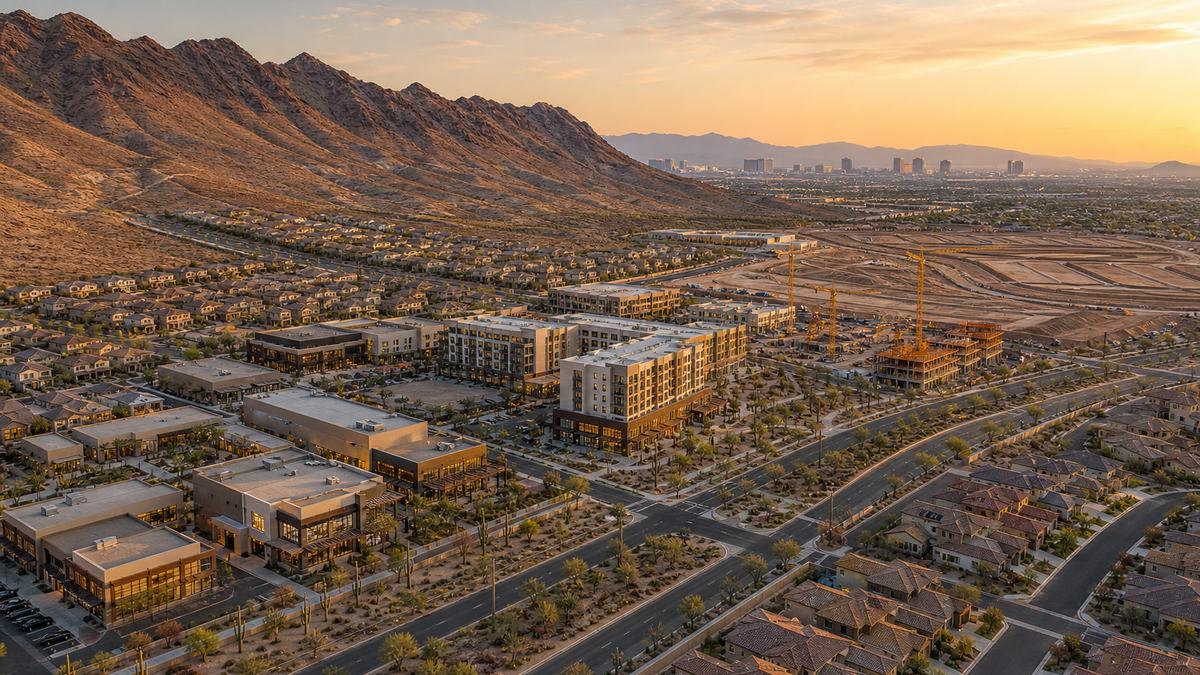
If you want to know where the next wave of growth in Las Vegas will go, don't look at the Strip skyline. Look south and southwest, toward the Henderson and southwest valley growth corridors: West Henderson along St. Rose Parkway, Inspirada and Cadence, the I-215 and Durango Drive area, and the southern stretch of Las Vegas Boulevard and I-15 that is moving toward Jean and, eventually, a second airport. That is where the new rooftops, the new office buildings and the new locals casinos are going.
Most commentary on Southern Nevada growth starts with demand: people keep moving here, so build more. We think that's backwards. Demand has been strong for years. What sets the pace in this valley is land, water and infrastructure, and almost all of the remaining land sits inside a federal boundary. Below is our take on where the growth is actually going, who wins, who may be disappointed, and how we would approach it as principal investors.
Henderson and the southwest valley are still the valley's growth engine, but the next phase will be more selective, more expensive and slower than the last one.
- The scale: Henderson now has about 369,000 residents, according to the city's demographic profile, up from about 266,000 in 2010.
- The proof: southwest Las Vegas had the lowest direct office vacancy in the valley, 5.8% at the end of 2025, and Station Casinos started a $385 million expansion at Durango in January 2026.
- The constraint: land. The BLM reported a little over 27,000 acres left for disposal inside the Southern Nevada boundary at the start of fiscal 2025, and much of it is hard to build on.
- The wild cards: the federal lands bill (up to 25,000 more acres over 50 years), Brightline West's station at the south end of the Strip, and a second airport near Jean in the 2030s.
- Our view: the best opportunities are in infill and edge parcels with utilities, neighborhood commercial and services that follow rooftops, and patient positions along the south I-15 corridor, not in paying peak prices for raw land.
Why the growth goes south and southwest
The Las Vegas Valley is a bowl surrounded by mountains and federal land. The north has Apex and the northwest has Skye Canyon and the new Tule Springs-area communities. The east is boxed in by Frenchman Mountain and Lake Las Vegas. Summerlin in the west is running up against Red Rock Canyon. That leaves the south and southwest, with Henderson to the southeast, as the corridors with the most room, the best freeway access and the strongest existing demand.
The numbers back that up. Henderson grew about 22% in the 2010s, from roughly 266,000 to 324,000 people, one of the fastest rates in the country among cities over 250,000, according to a StorageCafe analysis reported by News 3. The city's own demographic profile now puts the population at about 369,000. Henderson has also used land and money to attract anchors: the Las Vegas Raiders' headquarters and training center sits on a 55-acre site across from Henderson Executive Airport, with about 25 acres left for future development, according to LVSportsBiz.
| Corridor / project | What we know |
|---|---|
| Henderson population | About 369,000 (City of Henderson, ACS 2020–2024); about 266,000 in 2010 |
| West Henderson | Henderson West, about 103 acres on both sides of St. Rose Parkway, approved in 2020 for up to 2,900 homes, up to 670,000 sq ft of office and retail and 250 hotel rooms (KTNV). In 2024 the city asked the BLM to auction eight more parcels, about 58 acres south of St. Rose Parkway and west of Raiders Way (Review-Journal) |
| Raiders HQ | 55-acre site across from Henderson Executive Airport, about 25 acres held for future development (LVSportsBiz) |
| Inspirada / Cadence | Inspirada is in its final phases; Cadence (about 2,200 acres, east Henderson) is mid-buildout; Meriden by KB Home is opening in West Henderson (Nevada Real Estate Group pipeline review) |
| Inspirada Station | Station Casinos' planned resort near Via Inspirada and Bicentennial Parkway: about 900,000 sq ft over three stages, 600 hotel rooms; a 14.1-acre expansion approved by Henderson's Planning Commission in 2025; no firm construction start announced (KTNV) |
| Durango / I-215 | Durango Casino & Resort began a $385 million expansion in January 2026: about 275,000 sq ft, 400 more slots, 36-lane bowling, movie theaters and new restaurants, about 18 months of work (CDC Gaming) |
| UnCommons | Matter Real Estate Group's 40-acre, $850 million campus across from Durango; final office and retail building announced in May 2026 (FOX5) |
| South Strip / I-15 | Brightline West owns 110 acres on Las Vegas Boulevard between Blue Diamond and Warm Springs roads for its station, with room for transit-oriented development (Review-Journal via CDC Gaming) |
| Second airport | Southern Nevada Supplemental Airport site, about 6,500 acres roughly five miles south of Jean; draft environmental study expected by June 2027 (Las Vegas Advisor) |
When a casino operator commits $385 million to expand a property that opened in late 2023, and an office submarket posts single-digit vacancy while the rest of the valley sits around 12%, the market is telling you something. The southwest is no longer a suburb of the Strip. It is its own economy, built around locals, families and professional jobs, and that is a more durable base than tourism alone.
The southwest valley: a second center of gravity
The area around Durango Drive and the I-215 Beltway is the clearest example of what the southwest has become. Durango Casino & Resort opened in December 2023. By January 2026, Station Casinos had started a third phase, a $385 million expansion on the property's north parking lot that adds a bowling center, movie theaters, food hall outlets and entertainment venues, with existing amenities staying open during roughly 18 months of construction, according to CDC Gaming.
Across the street, Matter Real Estate Group's UnCommons has grown into a 40-acre, $850 million mixed-use campus with more than 350,000 square feet of office space and 385 luxury residential units, according to FOX5. BPM's June 2026 review of Las Vegas commercial real estate noted that southwest Las Vegas had the valley's lowest direct office vacancy at 5.8% at the end of 2025, while overall office vacancy was around 12% and downtown direct vacancy was 16.6%. BPM also reported that no significant new office construction was in the pipeline.
That combination, strong occupancy and very little new supply, is the kind of setup we look for. It doesn't mean every office building in the southwest is a buy. It does mean that well-located, newer space near amenities and housing has pricing power that older space elsewhere doesn't.
Henderson: the city that plans ahead
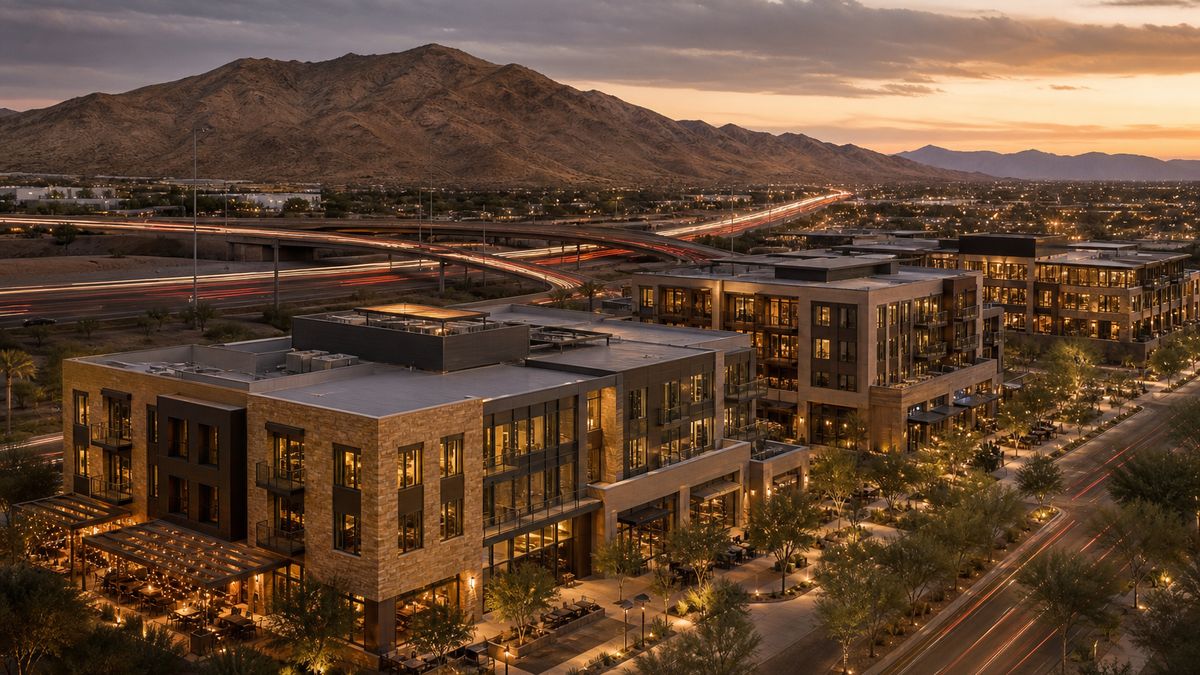
Henderson has done something many fast-growing cities don't: it has used its land, its planning tools and, at times, its balance sheet to shape what gets built. The city sold the Raiders their headquarters site at a discount, invested in hockey facilities for the Henderson Silver Knights and has pushed West Henderson as a mixed-use district rather than just more subdivisions. Not every investment has been free of controversy (LVSportsBiz tallied about $62 million in city commitments to three sports projects as of 2020), but the strategy has made Henderson a destination for employers and families.
The next phase looks different. Inspirada is in its final phases. Cadence, the roughly 2,200-acre community in east Henderson, is mid-buildout. In West Henderson, newer neighborhoods such as KB Home's Meriden are opening, and Station Casinos' planned Inspirada resort would add a locals casino anchor to the south end of the city. The land that remains is harder: sloping terrain, higher site costs and parcels that need federal disposal before anyone can build.
Henderson is also being more selective about what it wants. In July 2026 the city chose to require stricter, project-specific development agreements for data centers instead of adopting a moratorium, as we covered in our Apex data center analysis. That's a signal that Henderson will prioritize uses that fit its neighborhoods and its water and power capacity.
Henderson is moving from a land-rich growth city to a land-constrained, quality-focused one. That's good news for owners of well-located existing assets and for projects that solve a problem the city cares about, such as housing people can afford, jobs close to home and services for an aging population. It's harder news for anyone expecting cheap land and fast approvals.
The real constraint: federal land
Almost every serious growth discussion in Southern Nevada ends up at the Bureau of Land Management. Under the Southern Nevada Public Land Management Act of 1998, the BLM sells federal land inside a disposal boundary, usually after parcels are nominated by local governments. About 44,000 acres had been sold under the act as of mid-2024, according to the Review-Journal, and the BLM reported a little over 27,000 acres still available at the start of fiscal 2025. A meaningful share of that remaining land sits in flood channels, utility corridors, steep terrain or areas reserved for public use.
Recent deals show how much the remaining land is worth when it's buildable. In September 2026 the BLM finalized a $94 million sale of nearly 940 acres in the upper northwest valley to the City of Las Vegas for a master-planned community of up to 6,000 homes, according to FOX5. On the affordable side, the BLM proposed a direct sale of about 19 acres to the City of Henderson for affordable housing at $100 per acre, a below-market price allowed under the act.
The bigger question is Congress. The Southern Nevada Economic Development and Conservation Act would allow up to 25,000 more acres to be made available to Clark County over 50 years while protecting more than 2 million acres for conservation and recreation, according to Sen. Catherine Cortez Masto's office. A Senate subcommittee held a hearing in December 2025, but as of this writing the bill had not passed Congress. We'll go deeper on the land bill in a future post.
| Scenario | What it looks like | What it means for investors |
|---|---|---|
| Land bill passes, quick rollout | Congress expands the disposal boundary; Clark County and the cities nominate new parcels in the south and southwest within a few years | Pressure on land prices eases at the edge; builders and infrastructure providers benefit; infill values hold up but stop accelerating |
| Status quo (our base case) | Remaining SNPLMA land is sold slowly, mostly through nominated auctions and direct sales to cities | Buildable land stays scarce and expensive; infill, redevelopment and well-located commercial outperform; patience pays |
| Gridlock plus a weak housing market | No new federal land, higher mortgage rates and slower sales | Homebuilders slow down; land deals get repriced; disciplined buyers find better entry points in 2027–2028 |
Who wins: our ranking
1. Owners of entitled, serviced land
In a land-constrained valley, the scarcest asset isn't dirt. It is dirt with zoning, water, sewer and road access already in place. Owners who have done that work will set prices for the rest of the decade.
2. Neighborhood commercial and services
Rooftops pull retail, medical offices, childcare, fitness, restaurants and auto services. The southwest's office and retail story at UnCommons and Durango shows how quickly demand follows households. The next openings in West Henderson and the south end of the valley will need the same.
3. Locals gaming and entertainment
Station Casinos' Durango expansion and its planned Inspirada resort are bets on locals, not tourists. That's a separate demand stream from the Strip, and it tends to follow population growth more than visitation.
4. Homebuilders with land already in hand
Builders with lots controlled in West Henderson, Inspirada, Cadence and the southwest are in a strong position, even as higher mortgage rates slow sales. Land costs for the next round of lots will be higher.
5. Infrastructure, site work and construction supply
Sloping West Henderson parcels, new roads and utility extensions, a Brightline station and, eventually, an airport mean years of grading, aggregate, concrete and utility work. These businesses win across every scenario.
Looking at land or a project in Henderson or the southwest valley?
We help landowners, investors and operators pressure-test the land, infrastructure and entitlement assumptions behind a deal, structure partnerships and plan execution. Let's talk through what you're looking at.
Who may be disappointed
- Buyers paying peak prices for raw land: without entitlements and utilities, edge land can take years to become buildable, and federal land releases could add supply.
- Investors counting on rapid price gains: Las Vegas Realtors reported a September 2026 median single-family price of $470,000, flat year over year and below the record $490,000 set earlier this year. Sales were down 7.4% from a year earlier and supply was about five months, up from about four. This is a balancing market, not a runaway one.
- Speculative industrial developers in Henderson: BPM reported that North Las Vegas and Henderson had the highest industrial vacancy in the valley, and most speculative groundbreakings have paused.
- Anyone expecting the second airport soon: the draft environmental study is expected by June 2027 and a final decision around 2028. Even on schedule, the airport would likely open in the mid-2030s.
Where we see opportunity
Infill and "second-look" parcels
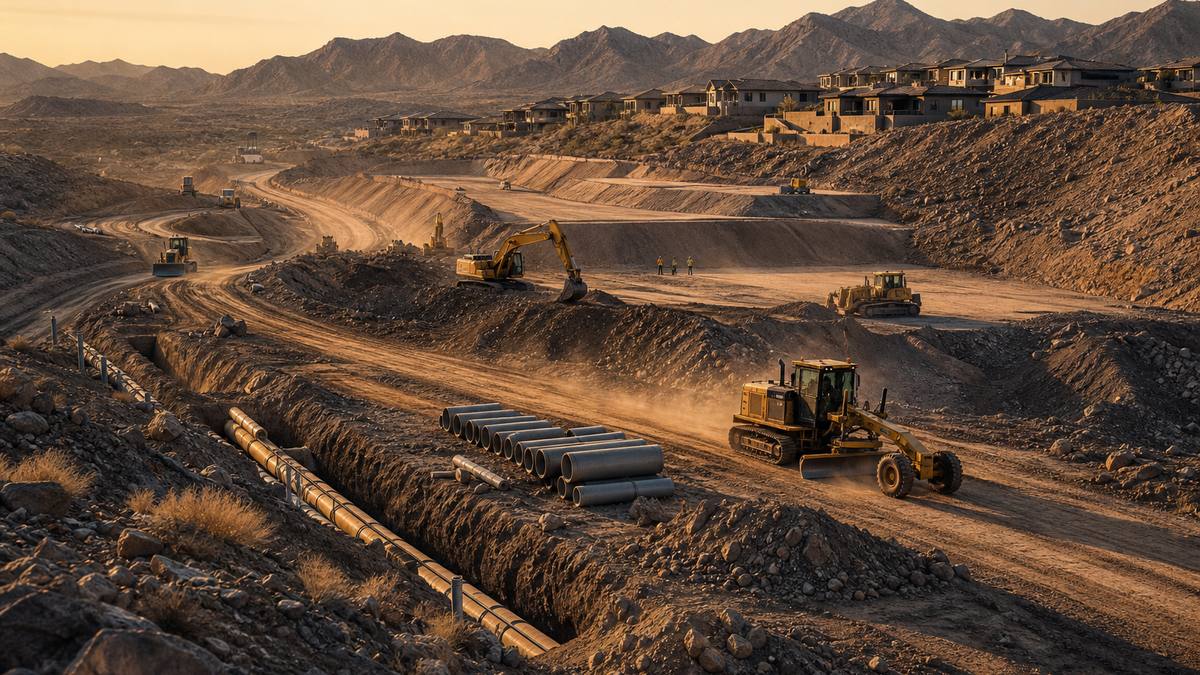
The easiest land in the south and southwest has been built on. The opportunity now is in parcels that others passed over: odd shapes, slopes, parcels needing a utility extension or a rezoning. These need more work, but they can be bought at prices that reflect that work. This is where experience in site work and entitlements matters most.
Services that follow households
Medical, senior living, childcare, education, fitness and everyday retail tend to lag new neighborhoods by a few years. We think senior and assisted living deserve particular attention in Henderson, which has long been popular with retirees. Our own pipeline includes a $2.5 million investment in a private assisted living community being built ground-up, so we watch this segment closely.
The south I-15 corridor, held patiently
Between the Brightline West station site on the southern end of Las Vegas Boulevard and the planned airport south of Jean, the I-15 corridor could look very different by the mid-2030s. Both projects carry real risk (see our Brightline West analysis), so we'd only take positions that make sense on their own merits today, with the big projects as upside.
Mixed-use and entertainment near locals anchors
Durango and UnCommons show that locals entertainment, offices and housing reinforce each other. The same pattern could repeat around Inspirada if Station's resort moves ahead. Smaller operators and landowners near these anchors can benefit from the traffic.
The risks we'd watch
- Interest rates and housing demand: Las Vegas Realtors linked September's slower sales directly to rising mortgage rates. Higher rates slow absorption and hurt land values first.
- Federal land policy: the timing and shape of the land bill, and how quickly new parcels reach auction, will affect land prices across the valley.
- Water: Southern Nevada has some of the strictest water conservation rules in the country. New development is designed around them, but Colorado River shortages could tighten the rules further.
- Site costs: the remaining West Henderson land often has slopes and rock that raise grading and utility costs. Budgets need real engineering, not rules of thumb.
- Tourism softness: locals-driven growth is more durable, but the valley's economy still leans on tourism. A long downturn there would hit jobs and spending everywhere.
- Big-project timing: Inspirada Station, Brightline West and the second airport all lack firm opening dates. Underwrite as if they're late.
How we would approach it
If we were advising a client, or putting our own capital to work, in Henderson or the southwest valley today, this is the framework we'd use:
- Start with land status, not location. Is it private or federal? Inside the disposal boundary? Zoned? Served by water, sewer and roads? Those answers matter more than which side of a freeway it's on.
- Underwrite at today's housing market. Use flat prices and slower absorption as the base case. Treat a quick recovery as upside.
- Price the site work honestly. Get grading, utility and road estimates early, especially on sloping West Henderson parcels.
- Follow the anchors. Locals casinos, employers like the Raiders' campus and major mixed-use projects pull demand. Position near them, not ahead of them.
- Stage commitments. Options, phased purchases and joint ventures keep flexibility while land policy and interest rates settle.
- Partner with people who execute. Entitlements, utility extensions and city relationships move projects in Nevada. Partner with operators who have done it before.
The bottom line
Henderson and the southwest valley will keep leading Las Vegas growth. The population is there, the locals economy is there, and the anchors (from Durango and UnCommons to the Raiders' campus and West Henderson) are already built or under way. What has changed is the pace-setter. The easy land is gone. From here, federal land policy, water, site costs and interest rates will decide how fast the next wave arrives and who makes money on it.
We think the winners will be the people who do the harder work: securing entitled, serviced land, building the services that follow households, and holding patient positions along the corridors that big infrastructure may eventually reach. If you're weighing an opportunity in Henderson or the southwest valley, we'd be glad to compare notes.
Frequently Asked Questions
Where is the next growth in Las Vegas going?
How fast is Henderson growing?
Why is land so limited in the Las Vegas Valley?
What is the Southern Nevada Economic Development and Conservation Act?
What is being built in the southwest Las Vegas Valley?
Is Station Casinos building a casino at Inspirada?
Are Las Vegas home prices still rising?
When will the new Las Vegas airport near Jean open?
Where are the best investment opportunities in Henderson and the southwest?
Does InTooWin work on land and development projects in Southern Nevada?
Talk to InTooWin about your next deal
Direct principals, not middlemen. We bring capital relationships, deal structure and hands-on execution. See our services or reach out directly.
Sources
- City of Henderson — Demographic profile
- News 3 Las Vegas — Three Nevada cities lead in U.S. growth (StorageCafe study)
- KTNV — Henderson West development approved by city council
- Las Vegas Review-Journal — Henderson asks BLM to sell land in western part of city
- LVSportsBiz — Henderson's sports facility investments
- Nevada Real Estate Group — New master-planned communities pipeline, 2026
- KTNV — Inspirada Station in Henderson approved for expansion
- CDC Gaming — Durango Casino starts $385 million expansion
- FOX5 Las Vegas — Office, retail space coming to UnCommons campus
- BPM — Las Vegas commercial real estate: who's building what (June 2026)
- CDC Gaming / Review-Journal — First look at Brightline's Las Vegas station
- Las Vegas Advisor — Ivanpah (Southern Nevada Supplemental Airport) update
- FOX5 Las Vegas — BLM finalizes $94M land sale for 6,000-home community
- Bureau of Land Management — Proposed land sale in Henderson for affordable housing
- Nevada Real Estate Group — Las Vegas vacant land supply and the BLM boundary (2026)
- Sen. Catherine Cortez Masto — Southern Nevada Economic Development and Conservation Act hearing (December 2025)
- FOX5 Las Vegas — Las Vegas Realtors September 2026 report
Related
This article is commentary and opinion based on publicly reported information as of October 2026. It is not investment, legal or financial advice. Project details, land prices, approvals and timelines may change; verify current information before making decisions. Images are AI-generated illustrations, not official renderings or photos of any project, community or company's property.