
Brightline West: Who Wins If It's Built, and the Risk It Isn't
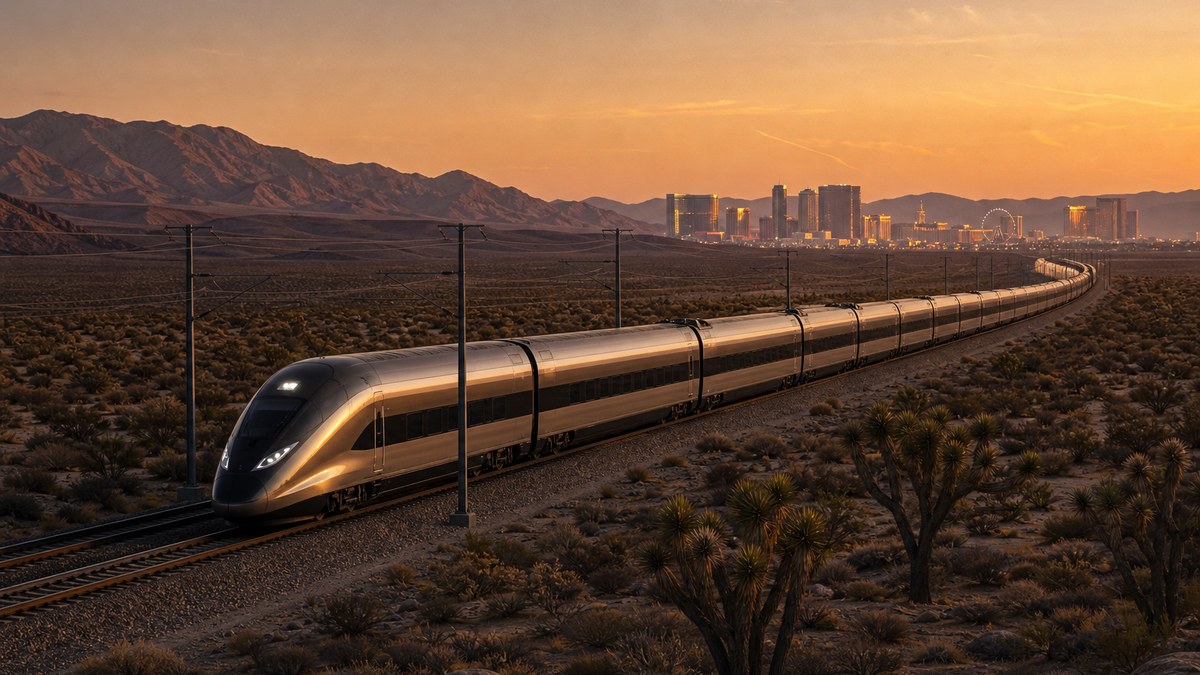
Brightline West, the proposed 218-mile high-speed rail line between Las Vegas and Southern California, may be the most consequential infrastructure project in Southern Nevada's pipeline. If it runs, it changes how the region's biggest drive-in market reaches the Strip. If it doesn't, it becomes one of the most expensive "almosts" in American transportation history.
Right now, it sits squarely between those two outcomes. The estimated cost has climbed to roughly $21 billion, the target opening has slipped to late 2029, a $6 billion federal loan is still under review, and on September 24, 2026, Brightline's Florida parent companies filed for Chapter 11. A $400 million equity deadline lands on November 2.
We are principal investors and operators, not rail fans or rail skeptics. Our job is to ask what a project like this does to land, demand and business plans, and to separate what is likely from what is merely promised. Here is how we read Brightline West today, who stands to win if it gets built, who could be hurt if it doesn't, and how we would position around it.
Brightline West is a real project with real federal backing, but its financing is not complete. Treat it as a high-impact option, not a certainty.
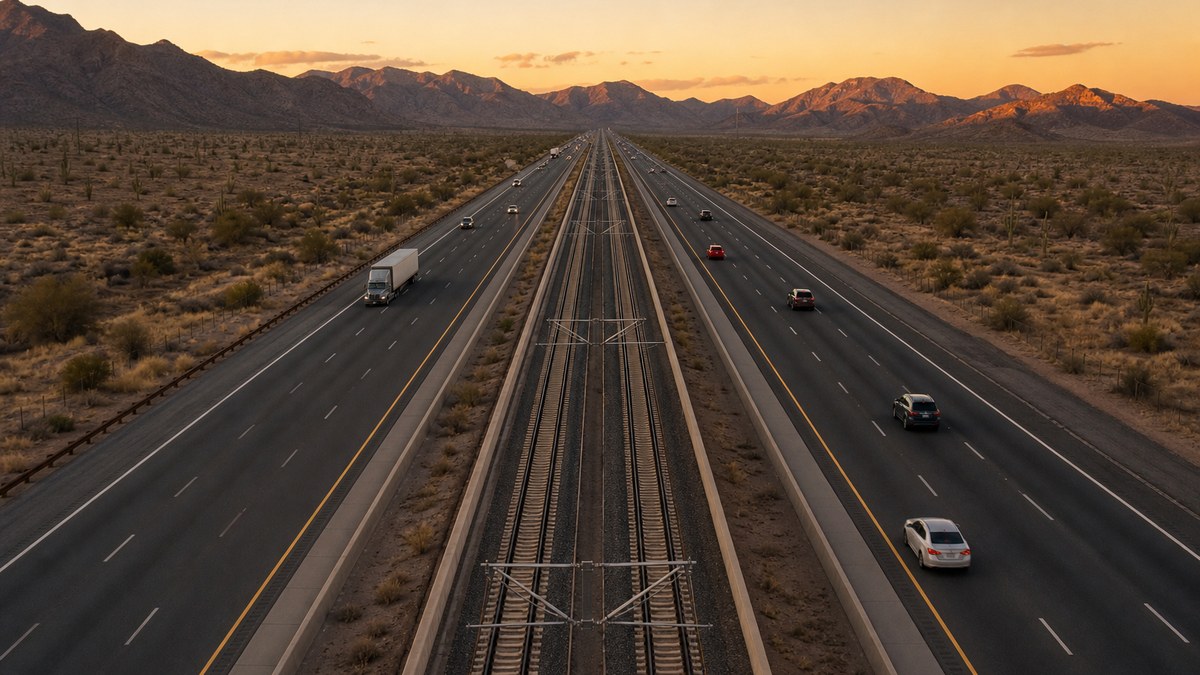
- The project: a 218-mile, all-electric line in the I-15 median from Rancho Cucamonga to a station south of the Strip, targeting about 2 hours 10 minutes end to end.
- The money: a $3 billion federal grant and $3.5 billion in private activity bond authority are in place; a $6 billion federal RRIF loan and new equity are still needed against a cost near $21 billion.
- The near-term tests: the $400 million equity deadline on November 2, 2026, and the outcome of the Build America Bureau loan review.
- If built: the south Las Vegas Boulevard corridor near the station, hospitality and mobility operators, and the I-15 logistics and industrial market stand to gain.
- Our view: position around the corridor with plans that work without the train, and treat the train as upside.
What is actually planned
Brightline West has been discussed in one form or another for well over a decade, which is part of why people tune it out. The current plan, according to project disclosures and public reporting, looks like this:
| Item | What we know |
|---|---|
| Route | About 218 miles, mostly in the median of Interstate 15, from Rancho Cucamonga, California to Las Vegas |
| Stations | Las Vegas (south of the Strip on Las Vegas Boulevard), Victor Valley (Apple Valley), Hesperia and Rancho Cucamonga |
| Las Vegas station site | A roughly 110-acre parcel between Warm Springs Road and Windmill Lane, near the Las Vegas South Premium Outlets; Brightline paid a reported $140 million for it in 2021 |
| Speed and trip time | Top speeds reported up to about 200 mph; about 2 hours 10 minutes end to end |
| Trains | Siemens American Pioneer 220 trainsets; first delivery reported for late 2027 |
| Cost | Roughly $21 billion as of late 2025, up from about $12 billion at the April 2024 groundbreaking |
| Secured funding | $3 billion federal grant (2023 award) and $3.5 billion in tax-exempt private activity bond authority |
| Still needed | A $6 billion federal RRIF loan under Build America Bureau review, new equity, and additional debt |
| Opening target | Late 2029, slipped from the original goal of service before the 2028 Los Angeles Olympics |
| Projected ridership | Nearly 11 million passengers a year, according to project projections |
Visible progress in Nevada has been real but modest: surveying along the route, a parking garage at the Las Vegas station site, a concrete tie plant in North Las Vegas and plans for a roughly 200,000-square-foot maintenance facility in Sloan. Reporting through September 2026 indicated that no track had been laid and major construction in California had not started.
The question is no longer whether Brightline West is a good idea. On paper, a fast train in one of the country's busiest leisure corridors makes sense. The question is whether the capital stack closes. Everything else is downstream of that.
Why the financing is the whole story
Big infrastructure rarely dies because engineers can't build it. It dies, or stalls for years, because the money doesn't line up in time. Brightline West's capital stack shows why investors are watching closely.
The cost has nearly doubled
At the 2024 groundbreaking, the project was described as roughly a $12 billion undertaking. By late 2025, reported estimates had risen to about $21 billion. Some of that is inflation and scope; some reflects the reality of building a high-speed line with federal "Buy America" requirements and new rolling stock. Whatever the cause, a near-doubling changes the equity and debt needed to finish.
The federal loan is the keystone
Brightline West is seeking a $6 billion Railroad Rehabilitation and Improvement Financing (RRIF) loan through the U.S. Department of Transportation's Build America Bureau. RRIF loans can offer low rates and repayment periods of up to 35 years. Bond Buyer reported that due diligence was expected to wrap up by late October 2026, followed by a formal review period of about 90 days if the project is invited to apply. Fox5 Las Vegas also reported the company was pursuing a separate bank financing of about $4 billion.
Bondholders have been patient, so far
Brightline West has roughly $2.5 billion in unrated bonds outstanding. Bond Buyer reported that bondholders agreed to a fifth amended agreement pushing a $400 million equity requirement from September 10 to November 2, 2026, after an earlier March 31 target was missed. The same reporting noted the senior 12% bonds traded around 61.5 cents on the dollar in late August. That price is the market's way of saying "possible, but far from certain."
The Florida filing complicates the picture
On September 24, 2026, Brightline's Florida holding companies filed for Chapter 11 in New Jersey to restructure about $2.5 billion in holding-company debt, with a restructuring support agreement and about $490 million in new long-term capital, according to Mass Transit. The Florida operating company did not file and trains kept running. Brightline West is a separate entity and was not part of the filing, and the company has said the bankruptcy has no bearing on the Las Vegas project. But one of the debtors reportedly holds about a 40% stake in Brightline West, and the two projects share bondholders. That kind of overlap tends to make lenders and federal reviewers ask harder questions.
Who wins if it's built
Assume for a moment that the capital stack closes and trains run by around 2029 or 2030. Here is how we would rank the beneficiaries.
1. The south Las Vegas Boulevard corridor
The station site sits south of the airport near the outlets, an area that has filled in steadily but has never had a single anchor capable of delivering millions of arrivals a year. A busy terminal changes the land-use math: hospitality, parking, food and beverage, car rental, short-term rental, flex and service uses all gain a reason to be nearby. This is the most direct real estate story, and also the one most exposed to timing risk.
2. Strip and off-Strip hospitality
Southern California has long been one of Las Vegas's most important feeder markets, and the I-15 drive is famous for Sunday-afternoon gridlock. A two-hour train that removes the drive could lift weekend frequency and make short midweek trips easier. Resorts that make the last mile from the station painless, with shuttles, loop connections or partnerships, will capture a disproportionate share.
3. Mobility and last-mile operators
Eleven million riders, if they show up, need to get from a station south of the airport to dozens of resorts, the convention center, the stadiums and neighborhoods across the valley. Shuttle fleets, rideshare staging, parking structures and any transit connection to the Strip become essential. These are cash-flowing businesses that scale with volume.
4. Nevada's industrial and construction base
Project materials have cited over 35,000 construction jobs across the route. Local trades leaders have publicly said Las Vegas has "more workers than work right now." A funded Brightline West would be a meaningful pipeline for contractors, suppliers, fabricators and equipment providers. The North Las Vegas tie plant and the Sloan maintenance facility already show the kind of industrial footprint the project brings.
5. The high desert
Victor Valley and Hesperia stations could make the high desert a more realistic place to live for people who work in Las Vegas or the Inland Empire, and vice versa. That is a longer-dated thesis, but corridor rail tends to reshape housing and logistics decisions over time.
The biggest winners from a train are rarely the people closest to the platform. They are the operators who solve the connection: the shuttle, the parking, the hotel partnership, the service business that turns a station arrival into a seamless trip. Access beats proximity, just as it does around stadiums.
Who may be disappointed
- Land buyers paying for the train today: anyone pricing a parcel as if trains arrive in 2029. If financing stalls, that premium has nothing underneath it.
- "Downtown Los Angeles to the Strip" assumptions: the western terminus is Rancho Cucamonga, not Los Angeles. Riders from coastal LA, Orange County or the Westside still need a connection, often via Metrolink, and that adds time and friction.
- Drive-market businesses on I-15: if the train works, some roadside fuel, food and lodging demand along the interstate shifts away.
- Bondholders and early equity: the current bond prices reflect real risk. Repeated deadline extensions buy time, but they don't build track.
- Anyone expecting instant ridership: new rail lines usually ramp up over several years. Opening-year numbers are rarely the steady state.
The risk it isn't built
This is where most commentary goes quiet, and where we think investors need to be most disciplined. There are three broad paths from here.
| Scenario | What it looks like | What it means for Southern Nevada investors |
|---|---|---|
| Funded and built | RRIF loan approved, equity raised, major construction starts in 2027; service around 2029–2030 | Corridor land and hospitality gain; mobility and services scale; construction pipeline strengthens |
| Delayed and restructured | Loan approved on new terms or later; ownership or financing restructured; opening slips into the 2030s | Value creation pushed out; carry costs bite; patient, staged positions outperform |
| Stalled | Financing fails to close; project paused or sold; site work idles | Train-dependent land premiums unwind; station-area land reverts to its non-rail value; plans built on the train need a new thesis |
Our base case sits between the first two rows: the federal government, the states and existing investors have a lot invested in seeing this line built, and the construction contracts have been executed, which Bond Buyer noted gives more cost certainty. But we would not underwrite anything that only works on the 2029 date. "Delayed and restructured" is the scenario we would plan around.
Looking at land or a business near the I-15 corridor?
We help investors, landowners and operators pressure-test infrastructure-driven deals, structure partnerships that survive delays and plan execution. Tell us what you're evaluating.
Where we see opportunity
The best opportunities around Brightline West share one trait: they make sense even if the train is late, and they get better if it arrives.
South-valley hospitality and extended stay
The area around the station site already benefits from the airport, the outlets, the I-15 and growth in the southwest valley. Well-run, mid-priced hospitality and extended-stay products have demand drivers today, from airline crews to construction teams to convention overflow, and a train would add another layer.
Parking, mobility and fleet services
Structured parking, rideshare staging and shuttle operations near the corridor serve the airport and resort traffic now. If the station opens, they become critical infrastructure. These are practical, operator-led businesses that don't need a finished district.
Industrial and flex space on the I-15
The Southern Nevada industrial market along I-15, from the south valley to Sloan and North Las Vegas, supports logistics, construction staging, fabrication and maintenance. A funded rail project adds tenants and suppliers; without it, the logistics thesis still stands on its own.
Construction supply and services
If financing closes, the project needs years of materials, equipment, labor housing, security, environmental services and logistics. Businesses positioned to serve multiple megaprojects, not just this one, are the safer bet.
Options, not ownership, near the station
For land near the station area, we prefer structures that buy time cheaply: options, ground leases, phased takedowns and joint ventures with existing owners. Pay for certainty when it exists, not before.
The risks we'd watch
- The RRIF decision: the single biggest variable. Watch for an "invitation to apply" from the Build America Bureau and the terms that come with it.
- The November 2 equity deadline: whether the $400 million arrives, gets extended again or triggers a restructuring.
- Sponsor health: how the Florida Chapter 11 process resolves and whether it affects ownership or appetite for Brightline West.
- Further cost growth: executed construction contracts help, but change orders, rail systems and rolling stock can still move.
- Political and policy shifts: federal transportation priorities change with administrations. The grant was awarded in one era; the loan is being reviewed in another.
- Ridership reality: nearly 11 million annual riders is a projection. The Rancho Cucamonga terminus, fares and last-mile connections in Las Vegas will decide the real number.
- Tourism cycles: Las Vegas visitation softened in 2025. A train adds convenience, but it doesn't make the city immune to the economy.
How we would approach it
If we were advising a family office, an operator or a landowner around Brightline West today, or deploying our own capital, this is the framework we would use:
- Underwrite without the train. The base case must work on the airport, the I-15, the southwest valley's growth and today's tourism. The train is upside.
- Price the option, not the outcome. If a seller wants a rail premium, structure it as contingent consideration tied to real milestones like loan close or track laying.
- Stage commitments to milestones. RRIF approval, financial close, start of major California construction and trainset delivery are the dates that matter.
- Favor operators over speculators. Value around transit gets captured by people who run things well: hotels, parking, fleets, services.
- Keep carry costs low. Delays are the most likely bad outcome. Structures that survive a two- or three-year slip are worth more than ones that need everything on time.
- Read the bond market. Bond prices and amendment terms often tell you more about the odds than press releases do.
This is the same discipline we use across our principal investment and business development work: separate the asset from the story, structure for the delays that usually come, and partner with people who can execute.
The bottom line
Brightline West is the kind of project that can reshape a region, and the kind that can sit half-finished for a decade. The next few months, the equity deadline, the federal loan review and the fallout from the Florida restructuring, will say a lot about which one it becomes.
Our advice is simple: don't bet against the corridor, and don't bet everything on the train. Southern Nevada's south valley and I-15 market have strong fundamentals of their own. Build plans that stand on those, keep your structure flexible, and let the train be the upside if and when it arrives. If you're weighing an opportunity tied to the corridor, or to Las Vegas infrastructure more broadly, we'd be glad to compare notes. You can also read our take on the A's ballpark, another south Strip project where timing and access drive the opportunity.
Frequently Asked Questions
What is Brightline West?
When will Brightline West open?
How much does Brightline West cost?
How is Brightline West funded?
Where is the Las Vegas station?
Does the train go to downtown Los Angeles?
Does the Brightline Florida bankruptcy affect Brightline West?
Who benefits most if Brightline West is built?
Should I buy land near the Brightline West station now?
Does InTooWin advise on Las Vegas infrastructure opportunities?
Talk to InTooWin about your next deal
Direct principals, not middlemen. We bring capital relationships, deal structure and hands-on execution. See how we work.
Sources
- Brightline West — project overview
- Railway Technology — Brightline West project details, stations and projections
- Bond Buyer — Bondholders grant more time as $6B federal loan timeline extended
- Mass Transit — Brightline Florida parent companies file Chapter 11
- Yahoo Finance — Brightline Florida files bankruptcy; is the West Coast project in doubt?
- Planetizen — Brightline West's future may rely on $6 billion federal loan
- NVBEX — Brightline West remains far from funding goal
- Fox5 Las Vegas — Brightline West still waiting on federal loan
- Casino.org — Las Vegas station site history
Related
This article is commentary and opinion based on publicly reported information as of October 2026. It is not investment, legal or financial advice. Project details, costs, financing and timelines may change; verify current information before making decisions. Images are illustrative and are not official project renderings.