
The Mirage Is Becoming Hard Rock Las Vegas. Is the Strip's Next Reinvention Cycle Here?
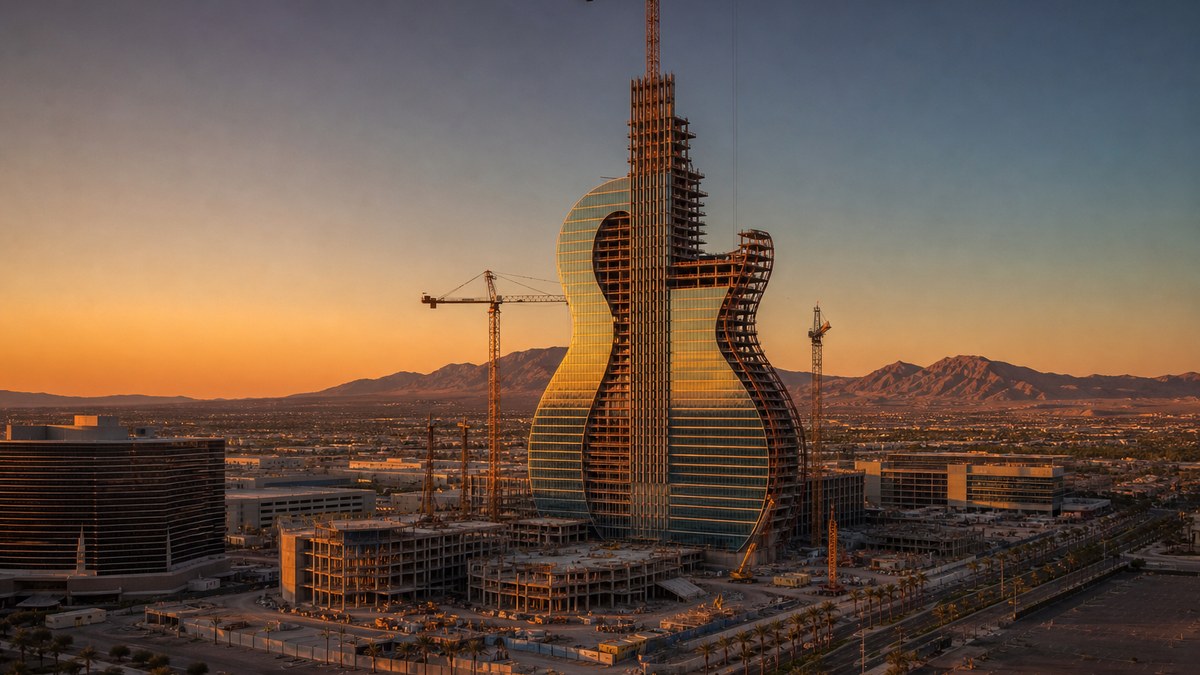
The Mirage changed Las Vegas once. When it opened in November 1989, Steve Wynn's $630 million resort, with its volcano, atrium and white tigers, set off three decades of megaresort building on the Strip. Now the same site is the center of the next experiment: Hard Rock Las Vegas, anchored by a roughly 660-foot, guitar-shaped hotel tower that is already one of the most visible structures on the Boulevard.
Most of the coverage asks whether the tower is an eyesore or a landmark. For investors, operators and landowners, that is beside the point. The better questions are what this project tells us about where the Strip is going, who captures the value, and who gets squeezed. We are principal investors with 30+ years of combined experience building, operating and exiting businesses, and we are in gaming ourselves: our pipeline includes a casino acquisition now in gaming commission licensing. So we watch projects like this one closely, and we have opinions.
Here is our take on what the Mirage-to-Hard Rock conversion really means, where we see opportunity, and the risks we would underwrite before committing capital anywhere near it.
Hard Rock is betting billions that a famous brand, a new landmark tower and bigger entertainment venues can win on the Strip's best-located block, even as tourism softens.
- The project: a full rebuild of The Mirage into Hard Rock Las Vegas, with a new 42-story guitar tower of about 675 rooms, roughly 3,600 to 3,700 rooms in total and a 5,000-seat Hard Rock Live venue, targeting a late-2027 opening.
- The money: Hard Rock has not disclosed an official cost. Its chairman suggested $4 billion to $5 billion back in 2023.
- The timing: it opens into a softer market. Strip visitation was down 4.3% year over year in August 2026, with room rates down 7.4%.
- Likely winners: center-Strip neighbors, entertainment and live-event suppliers, and service businesses that staff and supply a 6,000-worker resort.
- Our view: this is the start of a reinvention cycle, but the next wave will reward reinvention of existing assets, not new ground-up megaresorts.
What is actually being built
Let's start with the facts. Based on public reporting and company disclosures:
| Item | What we know |
|---|---|
| Owner / operator | Hard Rock International, owned by the Seminole Tribe of Florida. VICI Properties owns the real estate and leases it to Hard Rock. |
| Purchase | Hard Rock agreed in December 2021 to buy The Mirage's operations from MGM Resorts for about $1.075 billion and took over in December 2022 |
| Lease | Initial base rent of $90 million a year, a 25-year base term plus three 10-year renewals, with 2% annual escalators (per VICI's announcement) |
| Closure | The Mirage closed July 17, 2024; construction began the next day |
| Guitar tower | About 660 feet and 42 stories, with about 675 rooms and suites; topped out in spring 2026, according to reports |
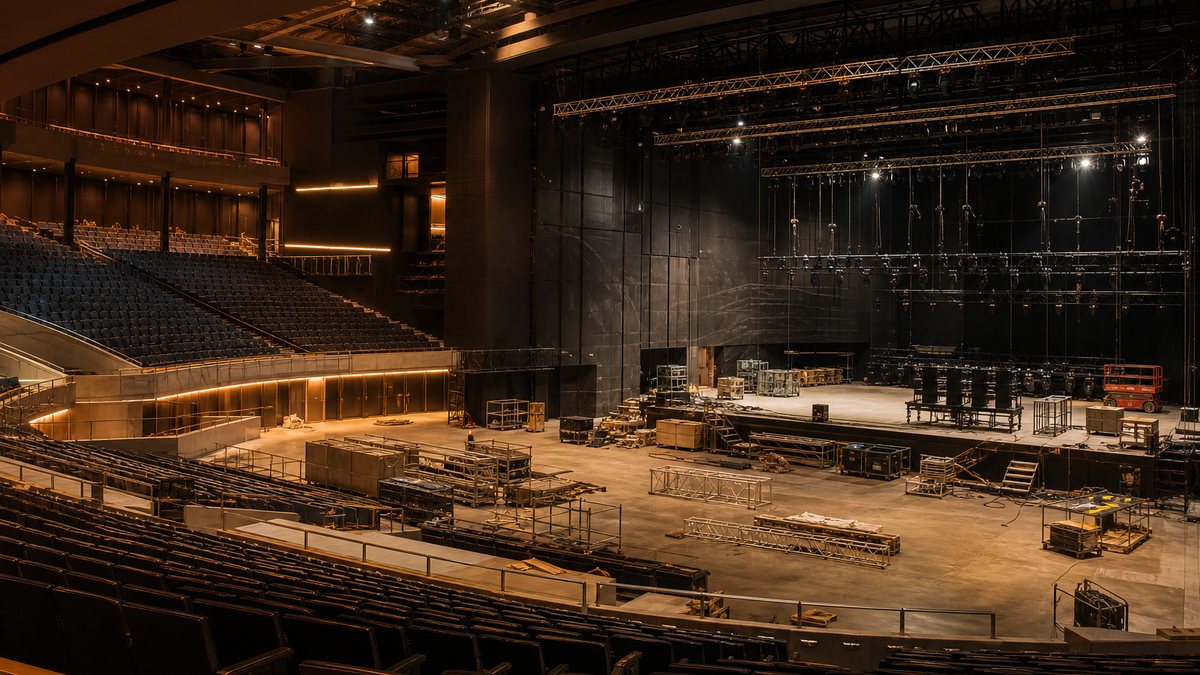
| Full resort | Roughly 3,600 to 3,700 rooms, about 175,000 sq ft of casino, a 5,000-seat Hard Rock Live venue and a proposed 2,000-seat West Theater |
| Cost | Not officially disclosed; chairman Jim Allen suggested $4 billion to $5 billion in 2023 |
| Opening | Targeted for the fourth quarter of 2027; Allen said in April 2026 the plan was late 2027 or early 2028 |
| Jobs | Up to about 6,000 workers expected when open |
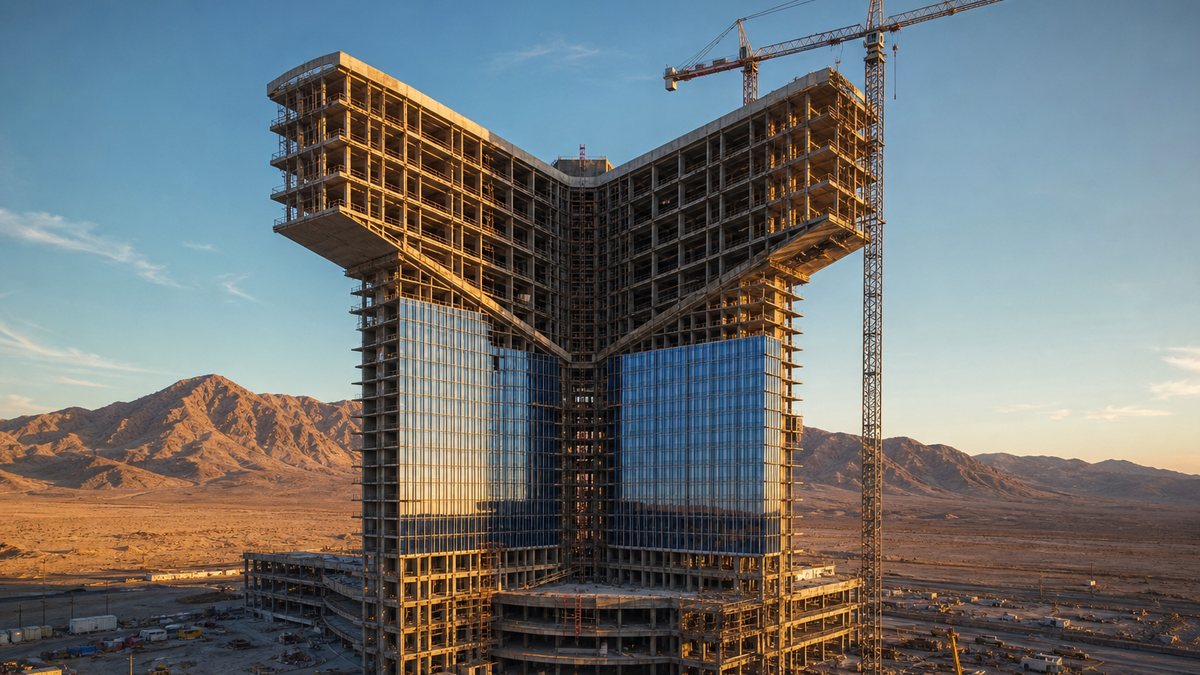
Two details deserve more attention than they get. First, this is not a renovation; it is a near rebuild. The volcano, the glass atrium, the porte cochere, the dolphin habitat and Siegfried & Roy's Secret Garden are gone, and the original tower has been gutted and re-skinned. Second, Hard Rock does not own the dirt. It owns the operating business and leases the real estate from VICI. That structure shapes almost everything about the risk.
Hard Rock is effectively making a multi-billion-dollar bet on a leased building. That is not unusual on today's Strip, where most major resorts sit under REIT leases, but it means the operator has to win on execution and brand, not on real estate appreciation. When the landlord collects a rising rent every year, the casino floor, the hotel and the venues have to carry the deal.
Why the Mirage closed at all
The Mirage was not a failing property. It was an aging one. Its tropical theme belonged to a different era of Las Vegas, and its 3,000-room Y-shaped tower was competing with much newer product. Hard Rock's choice was to keep running an older resort under a new name, or to close it, absorb the pain and rebuild it into something that can compete for the next 30 years.
It chose the second option, and the cost was real. More than 3,000 employees were laid off when the property closed, and Hard Rock said it expected to pay about $80 million in severance. Under the Culinary Union contract, laid-off workers kept the right to be recalled with seniority when the resort reopens.
That decision is the clearest signal in this story. A well-capitalized owner looked at a famous, cash-generating Strip resort and concluded that the old product could not earn its place. That logic applies to more than one property on the Boulevard.
Is this the start of a reinvention cycle?
We think so, and we think it looks different from the last one.
The 1989 to 2010 cycle was about new land and new megaresorts: The Mirage, Treasure Island, Bellagio, Venetian, Mandalay Bay, Wynn and CityCenter. The current cycle is about repositioning sites that already exist. Look at what is happening on the Strip right now:
- The Mirage is being rebuilt as Hard Rock.
- The Tropicana was demolished to make way for the Athletics' ballpark, with Bally's planning a resort around it. We covered that in our analysis of the A's ballpark.
- The Rio, just off the Strip, has been working through a multi-year renovation.
- Fontainebleau Las Vegas, after years as an unfinished tower, finally opened at the north end and is now the Strip's tallest hotel at about 729 feet.
The pattern is consistent. The best-located dirt on the Strip is already built. The value now comes from who can reinvent an existing site into something guests will choose over newer, louder competition. That is a very different skill set from ground-up development, and it favors operators with strong brands, deep balance sheets and the patience to close a property and rebuild.
The Strip's next decade will not be defined by who builds the biggest new resort. It will be defined by who reinvents the 1990s and 2000s inventory best. Several big resorts on the Boulevard are now 25 to 35 years old. Expect more closures, gut renovations and rebrands, and expect the winners to be the ones that treat the asset as a new product, not a facelift.
The timing problem: opening into a softer market
Hard Rock is building into a Strip that is not growing the way it was in 2022 and 2023. Las Vegas welcomed about 38.5 million visitors in 2025, down 7.5% from the year before, according to the Las Vegas Convention and Visitors Authority's year-end figures. The softness continued into 2026:
| Strip metric, August 2026 | Figure | Year over year |
|---|---|---|
| Visitor volume | About 3.03 million | Down 4.3% |
| Hotel occupancy | 74.1% | Down 3.4% |
| Average daily room rate | $150.32 | Down 7.4% |
| Strip gaming revenue | $684.1 million | Up 0.7% |
| Trailing 12-month Strip gaming revenue | Nearly $9 billion | Up 1.5% |
Read that table carefully. Fewer people are visiting, and rooms are being discounted, but gaming revenue is holding. That tells us the Strip's spending is concentrating among higher-value guests while the price-sensitive leisure traveler pulls back. Year-to-date room rates were still up almost 2%, so the pressure is real but not a collapse.
For Hard Rock, this cuts both ways. A softer market makes a 2027 opening harder to fill at premium rates. But the resort is aimed squarely at the guest who is still spending: concert-goers, premium players, groups and people who want a new experience rather than a cheap room. If the Strip is splitting into "premium" and "value," Hard Rock has clearly chosen premium.
Evaluating a hospitality or gaming opportunity in Las Vegas?
We are direct principals, not middlemen. We help investors, operators and landowners pressure-test deals, structure partnerships and plan execution. Tell us what you are looking at.
Who wins: our ranking
1. Hard Rock's brand, if it executes
Hard Rock has done this before. It bought the former Trump Taj Mahal in Atlantic City in 2017 and reopened it as Hard Rock a year later. Its Hollywood, Florida guitar tower became a regional landmark. A center-Strip flagship, on what Jim Allen called "the Strip's 50-yard line," puts the brand in front of tens of millions of visitors. If the resort lands well, the halo effect reaches every Hard Rock property and licensing deal worldwide.
2. Center-Strip neighbors
For more than two years, a major resort in the middle of the Strip has been a construction site. Neighboring properties and the pedestrian traffic between them have felt that gap. A reopened resort with major venues brings people back to this part of the Boulevard. The planned reopening of the tram linking Hard Rock and Treasure Island is a small but telling detail: connectivity matters.
3. Live entertainment and event suppliers
A 5,000-seat Hard Rock Live venue plus a proposed 2,000-seat theater means more show nights, more production work and more demand for staging, audio-visual, lighting, rigging, security and hospitality services. Las Vegas already has more major venues than almost any city. Each new one increases the competition for acts, but it also increases the total volume of work for the businesses behind the scenes.
4. The labor market and service economy
A resort that may employ up to 6,000 people needs recruiting, training, uniforms, food supply, transportation, maintenance and technology support. Those are steady, repeatable contracts that do not depend on a single headline weekend.
5. VICI, the landlord
VICI collects rent on a lease with built-in escalators while the operator funds most of the transformation. When the resort reopens as a stronger asset, the landlord owns a more valuable property. In this structure, the REIT is the quiet winner.
Who may be disappointed
- Mirage loyalists: the volcano, the atrium and the tropical identity are gone for good. Some longtime guests will not follow the brand change.
- Former employees who cannot wait: recall rights matter, but a gap of more than three years is a long time for a household to wait for a job to come back.
- Competing entertainment venues: every new major venue on the Strip competes for the same touring acts, residencies and event dollars. Older, smaller rooms may feel it first.
- Anyone expecting a quick opening-year payoff: big Strip openings often take two or three years to find their audience, their pricing and their operating rhythm.
- Value-seeking visitors: a premium-positioned resort will not help the Strip's affordability problem, which is part of why leisure visitation has softened.
Our scenarios for Hard Rock's opening
| Scenario | What it looks like | What it means for nearby investors |
|---|---|---|
| Strong launch | Opens late 2027 on schedule; venues book major acts; room rates hold at a premium | Center-Strip traffic rebounds; event and service suppliers benefit; other owners feel pressure to reinvest |
| Slow ramp | Opens on time or slightly late into a soft market; discounting in the first year; venues fill gradually | Steady demand for services and staffing; less pricing power; the halo arrives in years two and three |
| Delayed opening | Technology, fit-out or market conditions push the opening into 2028 | The center-Strip gap lasts longer; vendors with fixed start dates face cash-flow risk |
Our base case is a slow ramp: an opening in late 2027 or early 2028, strong curiosity at launch, and a year or two of pricing work before the resort settles into its position. We would underwrite to that and treat a strong launch as upside.
Where we see opportunity
Reinvention of aging hospitality assets
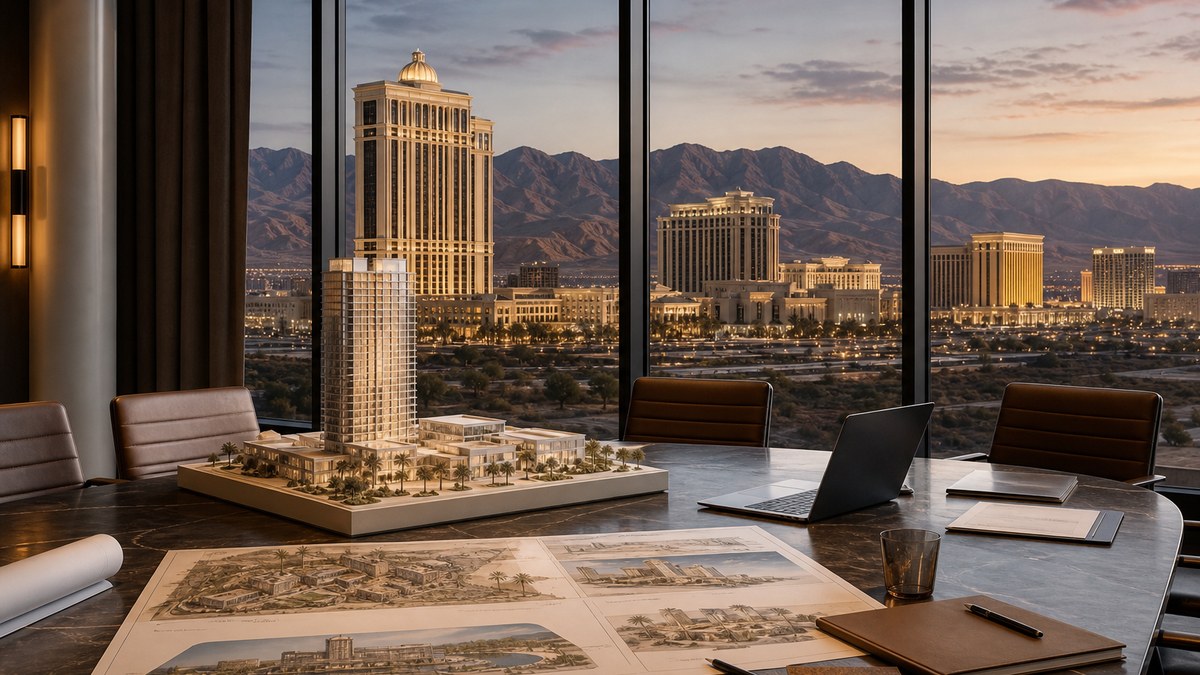
The single biggest lesson from The Mirage is that a great location with tired product is an opportunity, not a liability. The same logic applies off the Strip and in the wider valley: older hotels, locals casinos, motels and mixed-use properties that need a clear new concept, an operator and patient capital. This is where repositioning expertise and partnership structures matter most. See our services for how we approach it.
Services that scale with resort openings
Staffing, training, security, food and beverage supply, cleaning, fleet and logistics businesses all benefit from a 6,000-worker resort coming online. Companies that serve multiple resorts, rather than depending on one, are the strongest positions.
Live entertainment infrastructure
Production, staging, rigging, warehousing and fabrication space near the resort corridor is often overlooked while capital chases frontage on the Boulevard. Las Vegas keeps adding venues, and every one of them needs a supply chain.
Workforce housing and services
Thousands of returning and new resort jobs mean demand for attainable housing, child care and transportation close to the resort corridor. These are less glamorous than a casino but often more durable.
Smaller gaming assets
The headlines go to multi-billion-dollar projects, but gaming value also exists at a smaller scale, in properties where licensing, operations and capital structure can be improved. That is the part of the market we know firsthand from our own acquisition work.
The risks we'd watch
- Cost and financing: the official cost has not been disclosed. Allen has said Hard Rock is financing about 30% and funding about 60% with equity, and that he does not believe in being overleveraged. Cost growth on a project of this size is a constant risk.
- Opening date drift: the target has already moved from earlier plans to late 2027, and Allen tied the final date to newly signed technology deals. Every quarter of delay is a quarter without revenue.
- Tourism softness: August 2026 showed visitation and room rates still falling year over year. A premium resort can outperform a soft market, but it cannot ignore it.
- Rent escalators: a lease that rises every year regardless of performance raises the bar for the operating business.
- Venue competition: Sphere, the arenas, the stadiums, the resort theaters and, soon, the A's ballpark all compete for the same event calendar and visitor spend.
- Labor and regulation: rehiring thousands of workers under union agreements, and licensing a new flagship, takes time and careful planning.
How we would approach it
If we were advising a client, or deploying our own capital, around the Hard Rock conversion or the broader Strip reinvention cycle, this is the framework we would use:
- Underwrite the ramp, not the ribbon cutting. Model a slower first year, discounted rates and a two-to-three-year path to stabilization.
- Favor businesses that win across many resorts. Supply and service companies with diversified contracts carry less single-project risk.
- Look for reinvention candidates. Well-located, tired assets with a clear new concept often offer better risk-adjusted value than new construction.
- Respect the lease. In a REIT-owned market, understand who owns the dirt, how rent escalates and what capital commitments come with the deal.
- Partner with operators. In hospitality and gaming, value is created in operations: pricing, programming, staffing and service.
- Track the milestones. Opening-date announcements, venue bookings, hiring timelines and monthly LVCVA data will tell you more than any rendering.
The bottom line
The Mirage started the modern Strip. Its replacement may start the next chapter: a period in which the most important projects are not new resorts on empty land, but bold reinventions of famous sites that have aged out of their original concept. Hard Rock's guitar tower is the loudest example, and it will not be the last.
Whether Hard Rock Las Vegas is a home run depends on execution, timing and a tourism market that is still finding its footing. The opportunity for everyone else is in the businesses and properties that benefit from reinvention without carrying a multi-billion-dollar bet on a single opening date.
If you are weighing a hospitality, gaming or repositioning opportunity in Las Vegas, we would be glad to compare notes.
Frequently Asked Questions
What is replacing The Mirage in Las Vegas?
When will Hard Rock Las Vegas open?
How tall is the Hard Rock guitar hotel in Las Vegas?
How many rooms will Hard Rock Las Vegas have?
How much is the Hard Rock Las Vegas project costing?
Who owns the Mirage property?
What entertainment venues are planned?
What happened to Mirage employees?
Is now a good time to invest in Las Vegas hospitality?
Does InTooWin work on gaming and hospitality deals?
Talk to InTooWin about your next deal
Direct principals, not middlemen. We bring capital relationships, deal structure and hands-on execution to hospitality, gaming and development opportunities.
Sources
- The Nevada Independent — The latest on Hard Rock's Guitar Hotel tower (April 2026)
- Las Vegas Review-Journal — Hard Rock's guitar tower on pace for targeted opening
- Hard Rock Las Vegas — project overview and timeline
- VICI Properties — agreements relating to The Mirage (lease terms)
- NBC News / AP — The Mirage is closing (layoffs and severance)
- Casino.org — Las Vegas casino revenue flat in August 2026
- 500 Nations — Hard Rock Las Vegas construction updates
- Las Vegas Sun — Las Vegas tourism down 7.5% in 2025
Related
This article is commentary and opinion based on publicly reported information as of October 2026. It is not investment, legal or financial advice. Project details, costs and timelines may change; verify current information before making decisions. Images are AI-generated illustrations, not official renderings or photos of the project.