
Las Vegas Had Its First Down Year Since the Pandemic. Here's What the Tourism Reset Means for Investors.
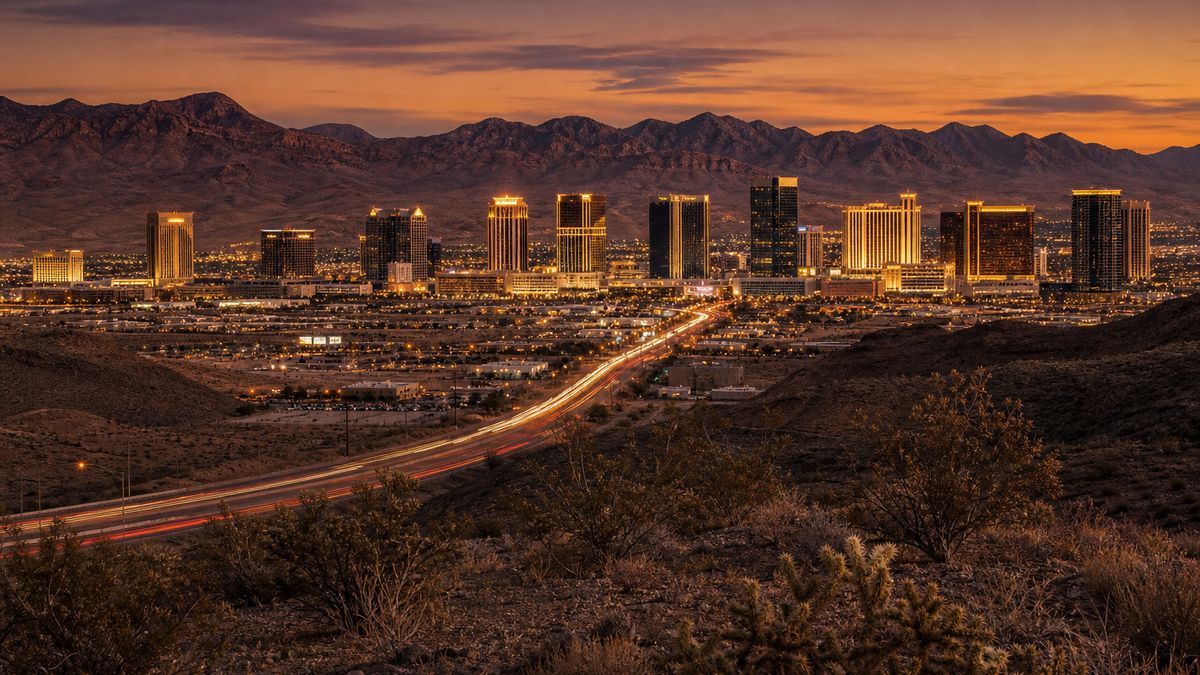
The Las Vegas tourism reset is the story every investor in Southern Nevada needs to understand right now. In 2025 the city welcomed about 38.5 million visitors, down 7.5% from the year before. That was the first annual decline since the pandemic, and it came after twelve straight months of year-over-year drops. Headlines called it a slump. Some called it the end of the "Vegas always wins" era.
We see it differently. Read the numbers closely and 2025 looks less like a collapse and more like a reset in who comes, how they get here and what they are willing to pay. Gaming revenue on the Strip still set a record. Convention attendance held. Luxury properties kept their rooms full. The pain landed on the value-conscious leisure traveler, the Canadian visitor and the budget flyer, and on the businesses that depend on them.
That distinction matters for anyone with capital, land or an operating business in the valley. As principals with 30+ years of combined experience building, operating and exiting companies, we have learned that a soft cycle is when the best entry points appear, and when the worst underwriting mistakes get made. Here is our take on what the softer numbers really say, who wins, who may be disappointed, and how we would approach Las Vegas hospitality and gaming today.
Las Vegas did not lose its appeal. It lost some of its affordability and accessibility, and the visitor mix shifted toward conventions and higher spenders.
- 2025: 38.5 million visitors (down 7.5%), occupancy 80.3%, average room rate $183.52 (down 5%), yet a record of roughly $8.8 billion in Strip gaming revenue.
- 2026 so far: visitation roughly flat (up 0.5% through July, then down 4.3% in August), conventions up about 10.5% year to date, airport passengers down about 7%.
- The pressure points: higher airfares, a 30% drop in Canadian visitors, the loss of Spirit Airlines capacity and price-sensitive leisure travelers.
- The signal: private capital is buying, not running. Fertitta Entertainment agreed to take Caesars private in a deal valued at about $17.6 billion.
- Our view: underwrite to the reset, not to the 2024 peak, and look for opportunity where the market is underserved: value, locals, conventions and well-run operations.
What the numbers actually say
Before forming an opinion, it helps to separate the data from the noise. Here is what the official figures and company reports show, as of mid-October 2026:
| Metric | What we know |
|---|---|
| 2025 visitors | About 38.5 million, down 7.5% from roughly 41.6 million in 2024 (LVCVA) |
| 2025 hotel performance | Occupancy 80.3% (down 3.3 points); ADR $183.52 (down 5.0%); RevPAR $147.30 (down 8.8%), still the third-highest on record |
| 2025 conventions | About 6.0 million attendees, nearly level with 2024 |
| 2025 Strip gaming revenue | About $8.8 billion, a record; Nevada statewide nearly $15.8 billion, a fifth straight record |
| 2026 visitors (through July) | 22.75 million, up 0.5%; convention attendance 3.9 million, up 11.2% |
| August 2026 | 3.03 million visitors (down 4.3%, partly a Labor Day calendar shift); occupancy 74.1%; ADR about $150 (down 7.4%) |
| 2026 room rates year to date | ADR about $183.60, up almost 2%; occupancy down about 0.3 points |
| Air travel | Harry Reid International passengers down about 7% year to date; August down 9% |
| Strip gaming, trailing 12 months | Nearly $9 billion, up about 1.5% |
Three things jump out. First, the drop in visitors was real, but the dollars held up much better than the headcount. Second, 2026 has been a year of stabilization, not recovery: visitation is roughly flat, conventions are carrying the load, and room rates are holding near 2025 levels. Third, the biggest drag right now is getting here. Airport traffic is falling faster than visitation, which tells you more people are driving or not coming at all.
Why visitors pulled back: the real causes
It became popular in 2025 to blame one thing: $30 resort fees, $20 cocktails and paid parking. Pricing mattered. But the full story has several moving parts, and each one points to a different kind of opportunity.
1. The cost of getting here went up
In September 2026, LVCVA President and CEO Steve Hill told Nevada's Economic Forum that jet fuel had roughly doubled from about $2 to $4 a gallon, peaking near $5. He said U.S. airfares are up about 12%, and fares into Las Vegas are up more than 20%. "What affects us an awful lot here in Las Vegas is jet fuel," Hill said. A destination that sells itself on easy, cheap weekend trips feels a 20% airfare increase immediately.
2. Low-cost air capacity shrank
Spirit Airlines' exit as a major low-cost carrier removed some of the cheapest seats into the market. Hill said more than half of those seats have been backfilled by other carriers, but not all of them, and not always at the same price. Harry Reid International handled about 30.2 million passengers so far in 2026 at the time of his presentation, down 6.86% from the year before.
3. International visitors, especially Canadians, stayed home
Canadian visitation is down about 30%, according to Hill, a loss he compared to the entire visitor volume from Australia. Canada has long been one of Las Vegas' most important international markets, and trade and political tensions turned a reliable stream of visitors into a headwind.
4. Value perception slipped
MGM Resorts CEO Bill Hornbuckle summed up the pricing problem on a 2025 earnings call: "You can't have a $29 room and a $12 coffee." Resort fees, parking charges and food and beverage prices created a perception that Las Vegas had become expensive, even when room rates were discounted. Some operators responded quickly. Resorts World Las Vegas, for example, waived its resort fee and parking charges during a 2025 summer promotion.
5. The visitor mix is changing
Hill also noted that visitors aged 21 to 29 and those 65 and older are declining, while the share aged 30 to 50 is rising. That is a subtle but important point. Younger, budget-driven travelers and retirees on fixed incomes are the most price-sensitive. The middle cohort spends more and travels more often for work and events.
This is a mix reset, not a demand collapse. Las Vegas lost the most price-sensitive visitors and kept the higher-spending ones. That is great news for luxury and convention-driven operators and hard news for anyone whose business model depends on volume at the low end.
Investors who keep treating Las Vegas as one market will misread it. There are now at least three: the luxury and convention Strip, the value Strip and downtown, and the locals market. They are moving in different directions.
A tale of three markets
The company results tell the same story from the inside.
- The luxury and convention Strip is holding. MGM Resorts reported second-quarter 2026 Las Vegas Strip revenue of about $2.17 billion, up 3%, with segment Adjusted EBITDAR of $735 million, also up 3%. Occupancy stayed at 93%. Room rates were down about 4%, so MGM kept its hotels full by pricing more sharply. Hornbuckle called it "a second consecutive quarter of year-over-year revenue growth for Las Vegas Strip Resorts."
- The value-oriented Strip is under more pressure. Caesars reported second-quarter 2026 Las Vegas revenue of about $1.02 billion, down 3.5%, and Adjusted EBITDA of $410 million, down 12.6%. Caesars has a larger share of mid-market rooms, and the slowdown has hit that segment harder.
- Downtown felt it too. In July 2026, downtown hotel occupancy was 58.5%, down 4.5 points, and RevPAR fell 7.4%, while the Strip's RevPAR rose. Downtown gaming revenue was down about 3% in August.
- The locals market is softer, not broken. Red Rock Resorts, owner of Station Casinos, reported second-quarter 2026 Las Vegas revenue of $503.2 million, down 2%, and Adjusted EBITDA of $227.5 million, down 5%. That is a modest decline for a business that depends on residents, not tourists.
One more data point stands out. Strip gaming revenue in August was up only 0.7%, but baccarat revenue rose 34% on a much higher hold rate. Take baccarat out and many table games and lower-denomination slots were down. High-end play is supporting the totals while the mass market is soft.
The biggest signal: capital is buying
If Las Vegas were truly in decline, you would expect capital to leave. The opposite is happening.
On May 27, 2026, Caesars Entertainment agreed to be acquired by Fertitta Entertainment, Tilman Fertitta's company, for $31 per share in cash, in a deal valued at about $17.6 billion including roughly $11.9 billion of debt. Caesars shareholders approved the deal on September 22, 2026. The FTC has issued a second request, and state gaming approvals are still needed, so the timing of the close is not yet set.
At the same time, construction continues on major projects. Hard Rock's guitar-shaped tower on the former Mirage site, a roughly $4 billion project with about 3,600 rooms, is targeting a late-2027 opening. The Athletics' ballpark is rising on the south Strip for 2028, and Hill estimates it could add about 400,000 visitors a year on its own. We covered both projects in detail in our insights on Hard Rock and the Strip's reinvention cycle and who wins from the A's ballpark.
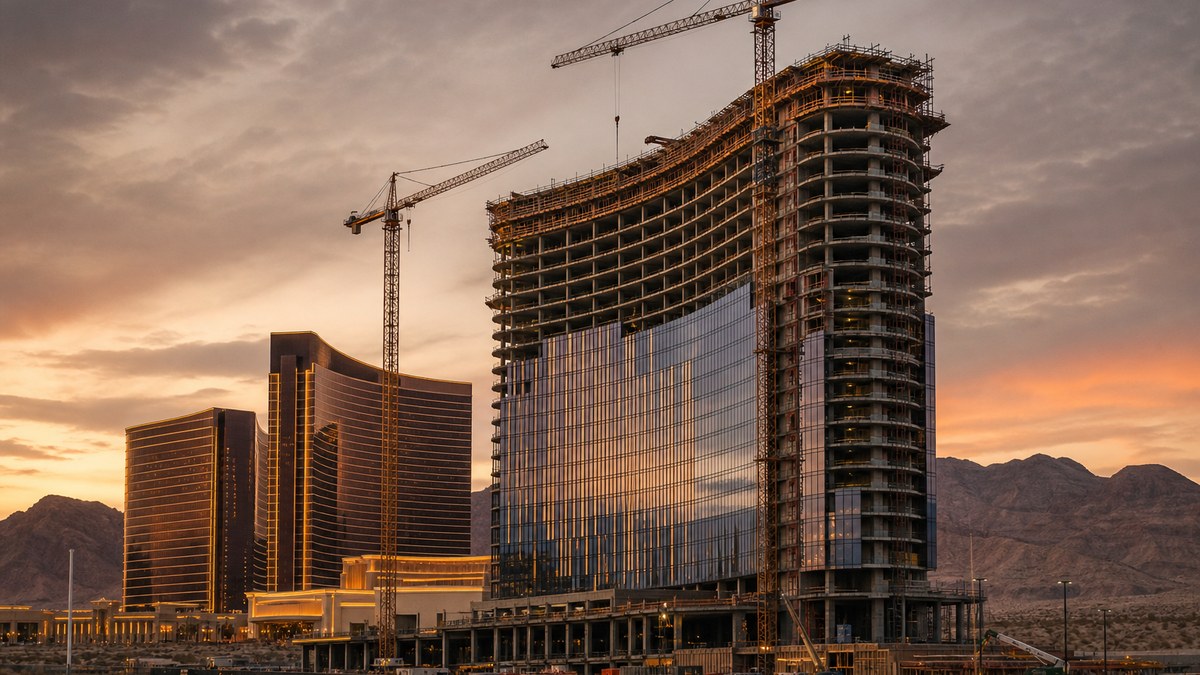
A take-private of Caesars in the middle of a soft patch is a vote of confidence from someone who knows hospitality better than almost anyone. Sophisticated buyers buy when the headlines are bad. That does not mean every Las Vegas asset is a bargain. It means the market is pricing a temporary problem as if it might be permanent, and patient capital sees an opening.
But be honest about the calendar. New supply arrives in 2027 and 2028 just as the market is still recovering. Plans that assume a quick return to 2024 visitation, rates and occupancy are speculation, not underwriting.
Looking at a hospitality or gaming opportunity in Las Vegas?
We help investors, family offices and operators pressure-test deals, structure partnerships and plan execution through the cycle. Let's look at it together.
Who wins in a reset
1. Luxury and convention-focused resorts
Convention attendance up more than 10% in 2026 is the single strongest number in the market. Group business books far in advance, fills midweek nights and spends heavily on food, beverage and meeting space. Operators with large convention footprints and premium rooms are best placed to ride this out.
2. Operators who fix the value equation first
Visitors have made it clear what they are tired of. The operators who simplify pricing, drop or bundle fees, and offer real value will take share from those who hold out. Hornbuckle's own argument is that Las Vegas is still competitive, with rates he cited at about 40% below New York and 7% below Los Angeles. The problem is perception, and perception can be fixed faster than infrastructure.
3. Well-capitalized buyers
Soft cycles reward buyers with patient capital and staying power. Owners who need to sell, refinance or reposition in 2026 and 2027 may accept terms they would not have considered in 2024. Private capital, family offices and strategic buyers with operating know-how are best positioned.
4. Event, convention and service businesses
Staffing, audio-visual, exhibit production, logistics, transportation and facility services all scale with conventions and events, not with leisure visitation. These businesses can grow even while overall visitor counts are flat.
5. The locals economy
Southern Nevada's population keeps growing, and residents keep spending on dining, entertainment and neighborhood gaming. Businesses that serve locals first are less exposed to airfares and international travel. We explored where that growth is heading in our insight on Henderson and the southwest valley.
Who may be disappointed
- Anyone underwriting to 2024: pro formas built on 41.6 million visitors and 2024 room rates may be off for several years.
- Pure volume plays: budget hotels, timeshare-style products and attractions that depend on large numbers of price-sensitive leisure visitors are most exposed.
- Downtown optimists who need a quick turnaround: downtown has real long-term potential, but recent occupancy and gaming numbers say patience is required.
- Businesses built on international or Canadian demand: until cross-border travel recovers, that demand will be thin.
- Anyone counting on the forecasts alone: UNLV's Center for Business and Economic Research suggested in June 2026 that visitation could reach about 40.5 million this year, a roughly 5% gain. With year-to-date numbers roughly flat, that looks ambitious.
Where we see opportunity
Value-forward hospitality
The market has clearly signaled demand for simpler, fairer pricing. Well-run midscale, extended-stay and select-service hotels, off-Strip or near the convention corridor, can win guests who want Las Vegas without the resort fees. The opportunity is less about building new rooms and more about buying or repositioning existing ones at the right price.
Convention-adjacent real estate and services
With convention attendance leading the market, properties and businesses near the Las Vegas Convention Center and the major meeting resorts are worth a close look: flex space for exhibit production and storage, transportation and staffing businesses, food and beverage concepts that serve attendees between sessions.
Locals-focused gaming and entertainment
Neighborhood casinos, taverns, dining and family entertainment that serve the valley's growing population are less exposed to airfares and border politics. We see this segment as one of the more resilient parts of the market, which is one reason gaming is part of our own pipeline: InTooWin has invested $18 million in a casino acquisition that is now in gaming commission licensing.
Operational turnarounds
Some assets are not struggling because of the market. They are struggling because of how they are run. Pricing, labor scheduling, marketing, food and beverage and capital planning can all move margins. Owners who bring in experienced operators or partners can create value that does not depend on visitation recovering.
Non-gaming experiences
Hill pointed out that visitor spending rose 52% from 2019 to 2025, even as visitation softened. Visitors are spending on shows, sports, dining and experiences. Concepts that give people a reason to come back, especially repeat visitors in the 30 to 50 age group, have room to grow.

Three scenarios for 2027–2028
| Scenario | What it looks like | What it means for investors |
|---|---|---|
| Steady recovery | Air capacity and fares normalize, Canadian travel improves, conventions stay strong; visitation climbs back toward 40 million | Rates firm up; value-add and repositioned assets outperform; new supply absorbed by 2028 |
| Long plateau | Visitation stays near 38–39 million; conventions and high-end play carry the totals; new rooms arrive in 2027–2028 | Winners are operators with a clear segment and tight costs; mid-market assets face pricing pressure |
| Second leg down | Broader U.S. slowdown, higher fuel costs or weaker consumer spending hits leisure and some group demand | Distressed sellers emerge; patient, low-leverage capital finds the best entry points |
Our base case is the long plateau, with gradual improvement as the ballpark opens and air capacity rebuilds. Underwrite to it and treat a faster recovery as upside.
The risks we'd watch
- Air capacity and jet fuel: the airport numbers are the leading indicator. Watch monthly passenger counts and new route announcements.
- International travel: Canadian visitation is down about 30%. A recovery depends partly on factors outside Nevada's control.
- New supply: about 3,600 Hard Rock rooms in late 2027 plus a new ballpark in 2028 add demand generators and competition at the same time.
- The consumer: price-sensitive leisure travel is the first thing households cut. A broader slowdown would hit the value segment hardest.
- Convention concentration: conventions are carrying the market. Show rotations and calendar shifts can swing monthly results, as August showed.
- Ownership changes: the Caesars take-private still needs FTC and state approvals. A change in ownership can change pricing, capital spending and vendor relationships across a large share of the Strip.
- Labor and operating costs: softer revenue with rising costs squeezes margins. Watch for further cost cutting and what it does to service quality.
How we would approach it
If we were advising a client, or deploying our own capital, in Las Vegas hospitality and gaming today, this is the framework we would use:
- Re-base your underwriting. Start from 2025 and 2026 actuals, not the 2024 peak. Model a plateau case and make sure the deal still works.
- Pick your market. Decide whether you are underwriting the luxury and convention Strip, the value segment or the locals market. They have different drivers and different risks.
- Buy the gap, not the headline. Look for assets where operations, pricing or capital structure, not location, are the problem. Those are the gaps an experienced partner can close.
- Keep leverage sensible. Soft cycles punish tight debt service. Structure deals to survive a longer plateau than you expect.
- Partner with operators. In hospitality and gaming, value comes from execution. Joint ventures that pair capital with a proven operator reduce risk on both sides.
- Track the leading indicators. Airport passengers, convention calendars, monthly LVCVA and Gaming Control Board reports and operator earnings will tell you more than any forecast.
This is the kind of work we do every day through our capital raising, deal structuring and execution services.
The bottom line
Las Vegas did not stop being Las Vegas. It priced out some of its most cost-sensitive visitors, lost cheap air seats and Canadian travelers at the same time, and leaned harder on conventions and high-end play. The result is a market that looks weak in visitor counts but remains strong in spending, and a market that is splitting into segments with very different futures.
For investors, that is not a reason to stay away. It is a reason to be precise. The best opportunities in a reset go to people who underwrite conservatively, choose their segment deliberately and partner with operators who can execute. That is how we approach it, and we would be glad to compare notes on what you are seeing. You can read more of our thinking on our Insights page, including our views on Brightline West, which could reshape how Southern Californians get to Las Vegas, and on Apex and the valley's industrial growth.
Frequently Asked Questions
How many people visited Las Vegas in 2025?
Is Las Vegas tourism still down in 2026?
Why did fewer people visit Las Vegas?
If visitors fell, why did gaming revenue hit a record?
Are Las Vegas hotel room rates falling?
What does the Caesars sale to Fertitta Entertainment mean?
Which parts of the Las Vegas market are holding up best?
Will Las Vegas tourism recover?
Is now a good time to invest in Las Vegas hospitality or gaming?
Does InTooWin invest in or advise on Las Vegas hospitality deals?
Talk to InTooWin about your next deal
Direct principals, not middlemen. We bring capital relationships, deal structure and hands-on execution, in good cycles and soft ones.
Sources
- LVCVA — Las Vegas welcomes 38.5 million visitors in 2025
- Las Vegas Strip tourism slumped despite record 2025 gaming revenue
- FOX5 Las Vegas — July 2026 visitor volume and year-to-date figures
- News 3 Las Vegas — August 2026 tourism figures
- Casino.org — Las Vegas casino revenue and tourism, August 2026
- KTNV — LVCVA's Steve Hill at Nevada's Economic Forum, September 2026
- CoStar — MGM Resorts CEO on the Las Vegas rebound
- MGM Resorts — second quarter 2026 results (SEC filing)
- Caesars Entertainment — second quarter 2026 results (SEC filing)
- Red Rock Resorts — second quarter 2026 results (SEC filing)
- Hotel Dive — Caesars acquired by Fertitta Entertainment in $17.6B deal
- Acquiry — Caesars–Fertitta vote results and regulatory status
- UNLV CBER — Las Vegas tourism decline: 2026 may look better
- CDC Gaming — Hard Rock Las Vegas pacing toward 2027 opening
- Action Network — How Las Vegas is reviving its reputation for value
Related
This article is commentary and opinion based on publicly reported information as of October 2026. It is not investment, legal or financial advice. Figures, forecasts and timelines may change; verify current information before making decisions. Images are AI-generated illustrations for editorial purposes, not photographs or official renderings of any property.